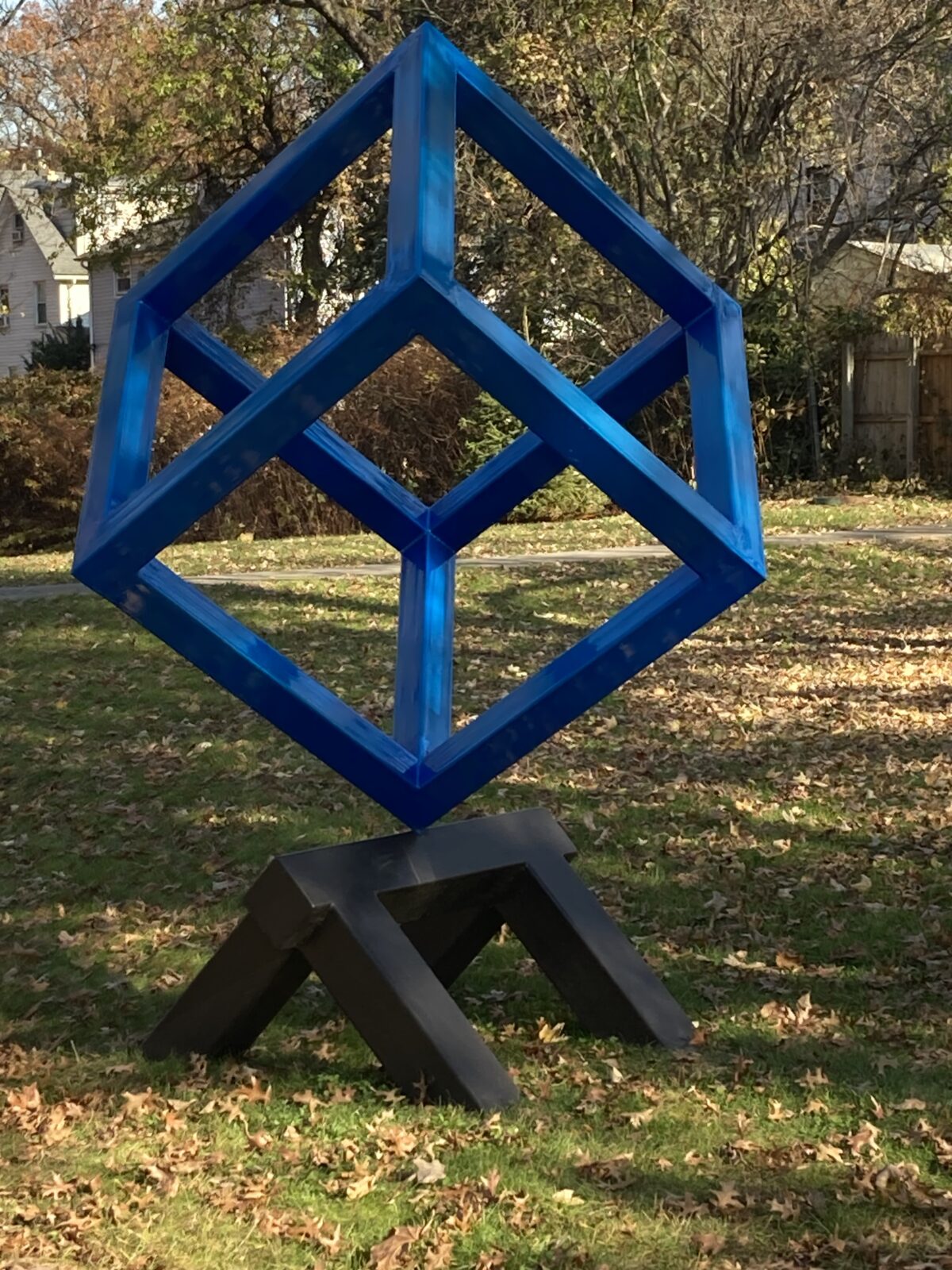
Blue Cube

“This sculpture stands out in any environment, bringing an inner sense of balance and serenity. It allows one thing to recede and another to emerge. Everything in balance to another.” – Lenny Harrington

“This sculpture stands out in any environment, bringing an inner sense of balance and serenity. It allows one thing to recede and another to emerge. Everything in balance to another.” – Lenny Harrington
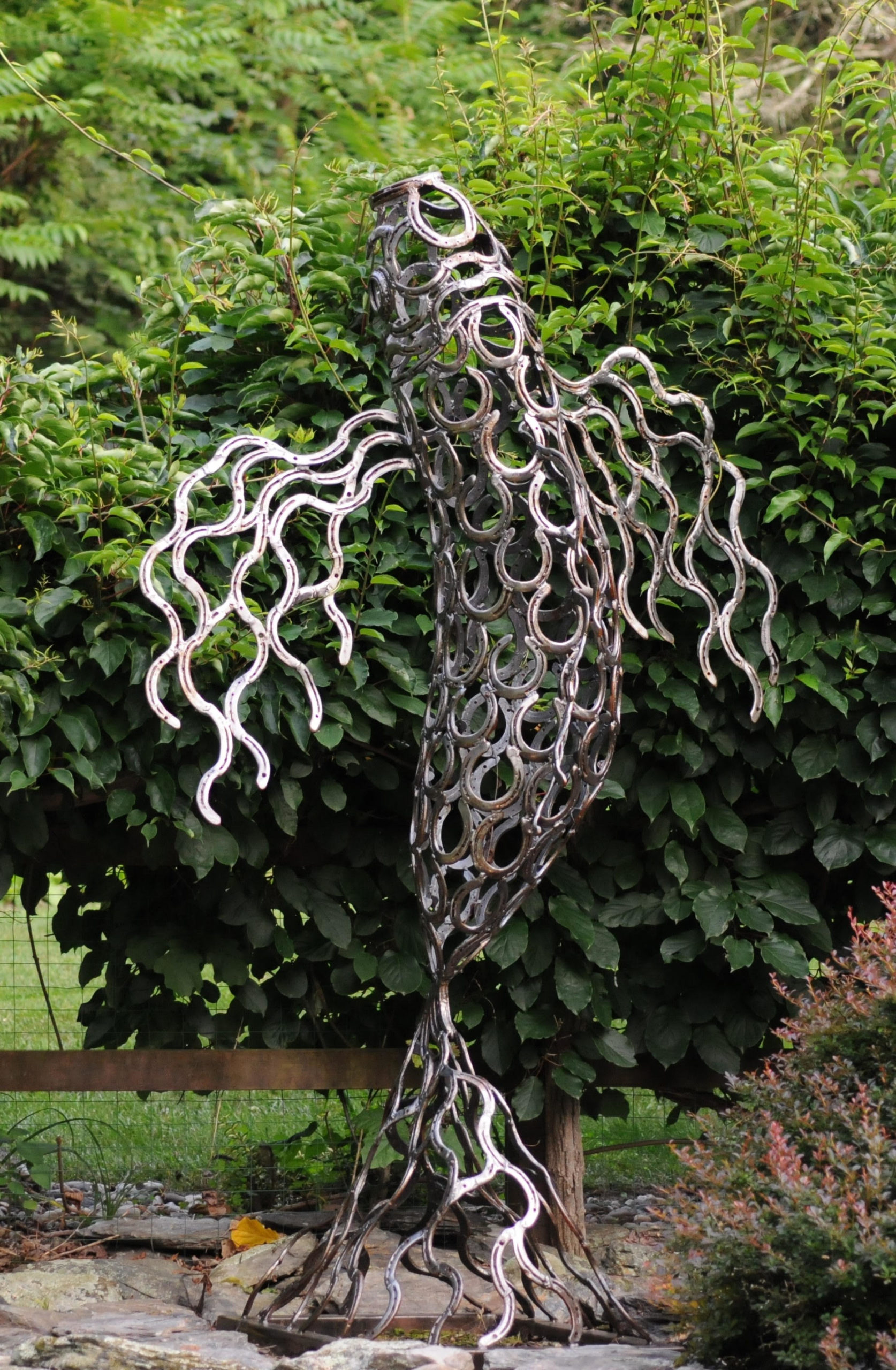
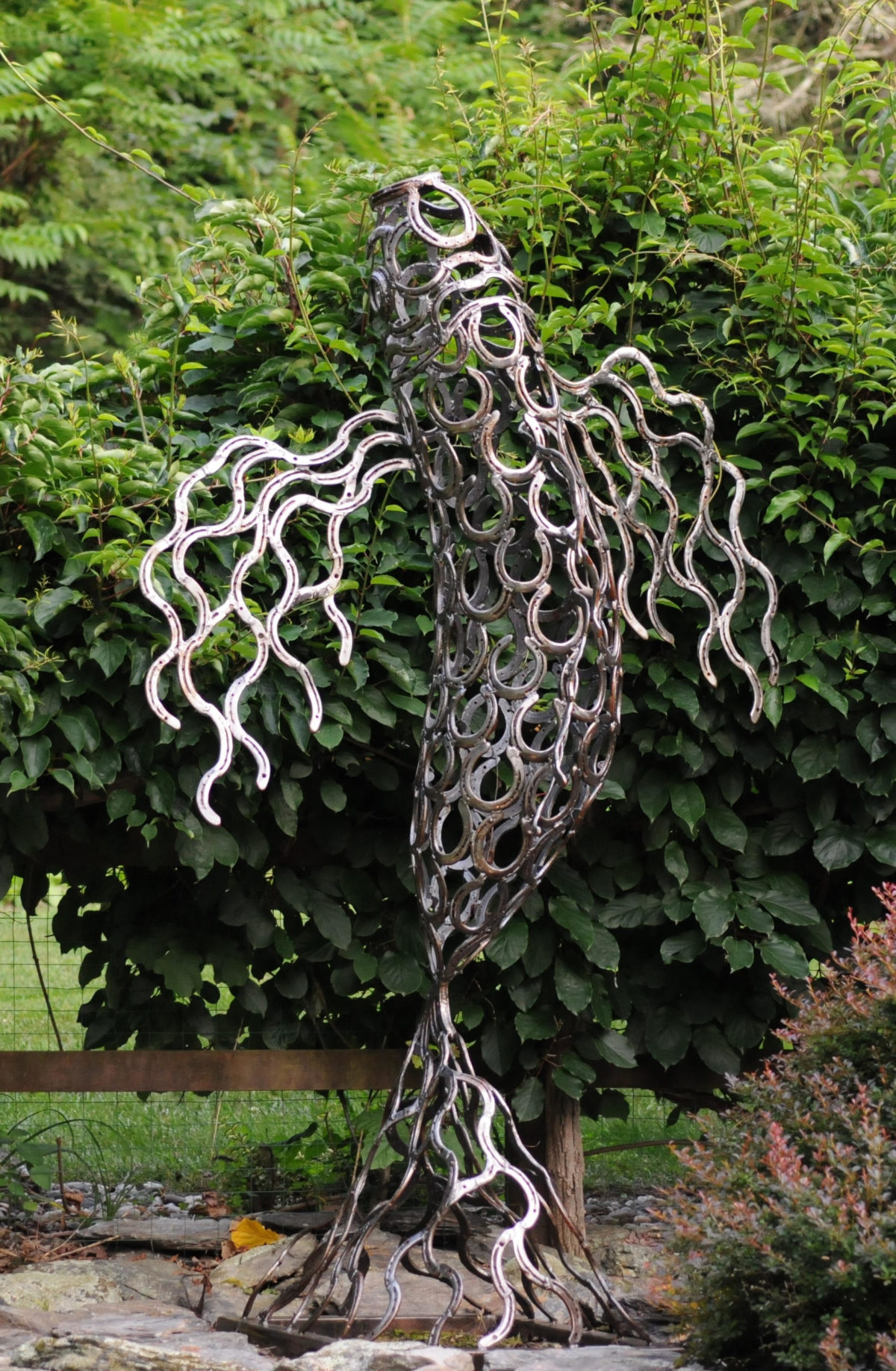
“Springtime” represents a koi fish emerging from hibernation in the spring, and symbolizes renewal in the everchanging circle of life. It is made from upcycled horseshoes which have left their own impressions throughout their lifespan.
My sculpting career started after suffering a profound loss, and has allowed me to channel my emotions into something tangible. These emotions are brought to life in different forms which allows people to see, as well as feel, what is going on in my pieces. I work with many different materials including metal, wood, and cast stone. My ability to take these materials and transform them into works of art that have such personality keeps me grounded and connected to my inner self.
-Brian Wohrman
For more information visit brianwohrman.com or Instagram @brianwohrman
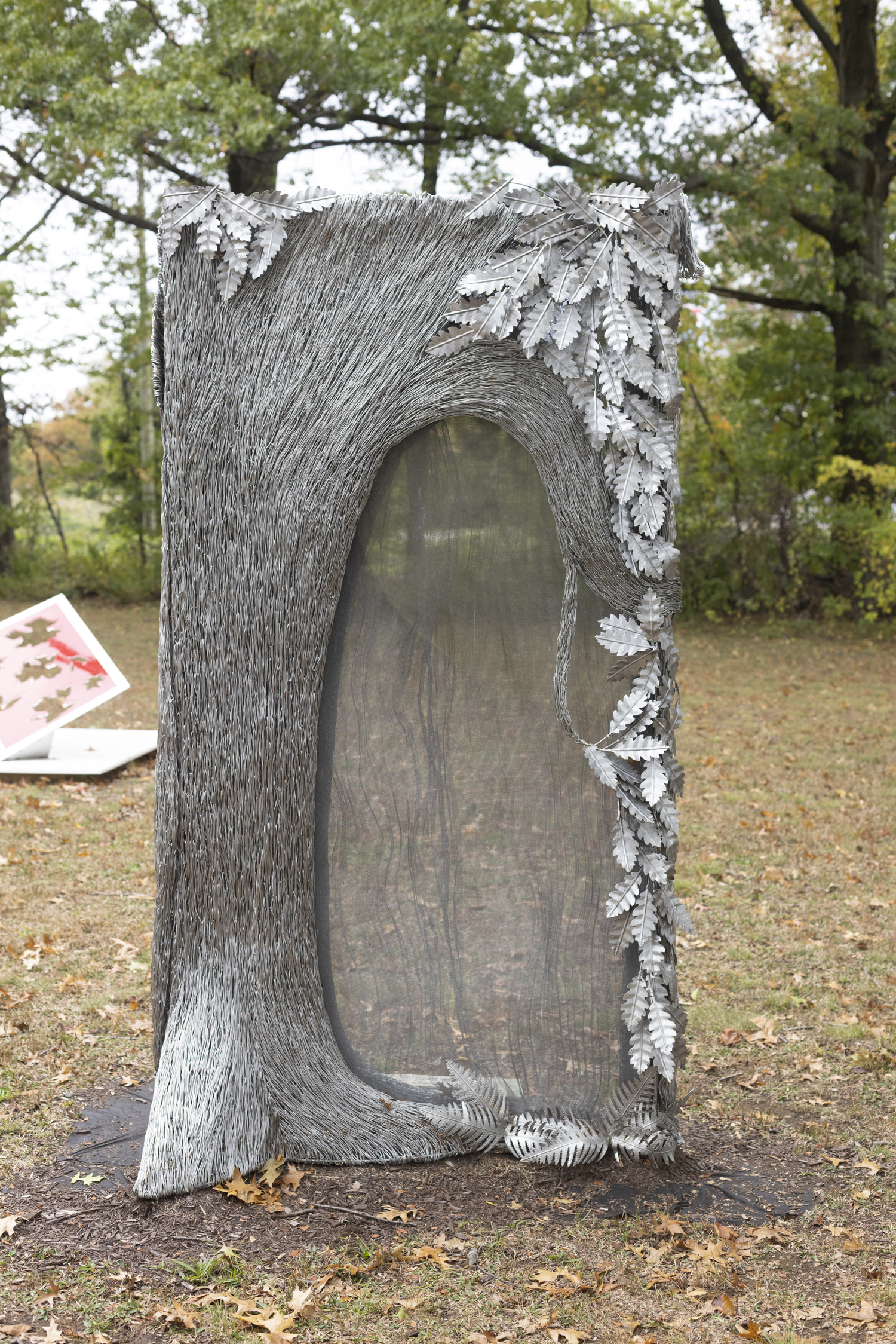


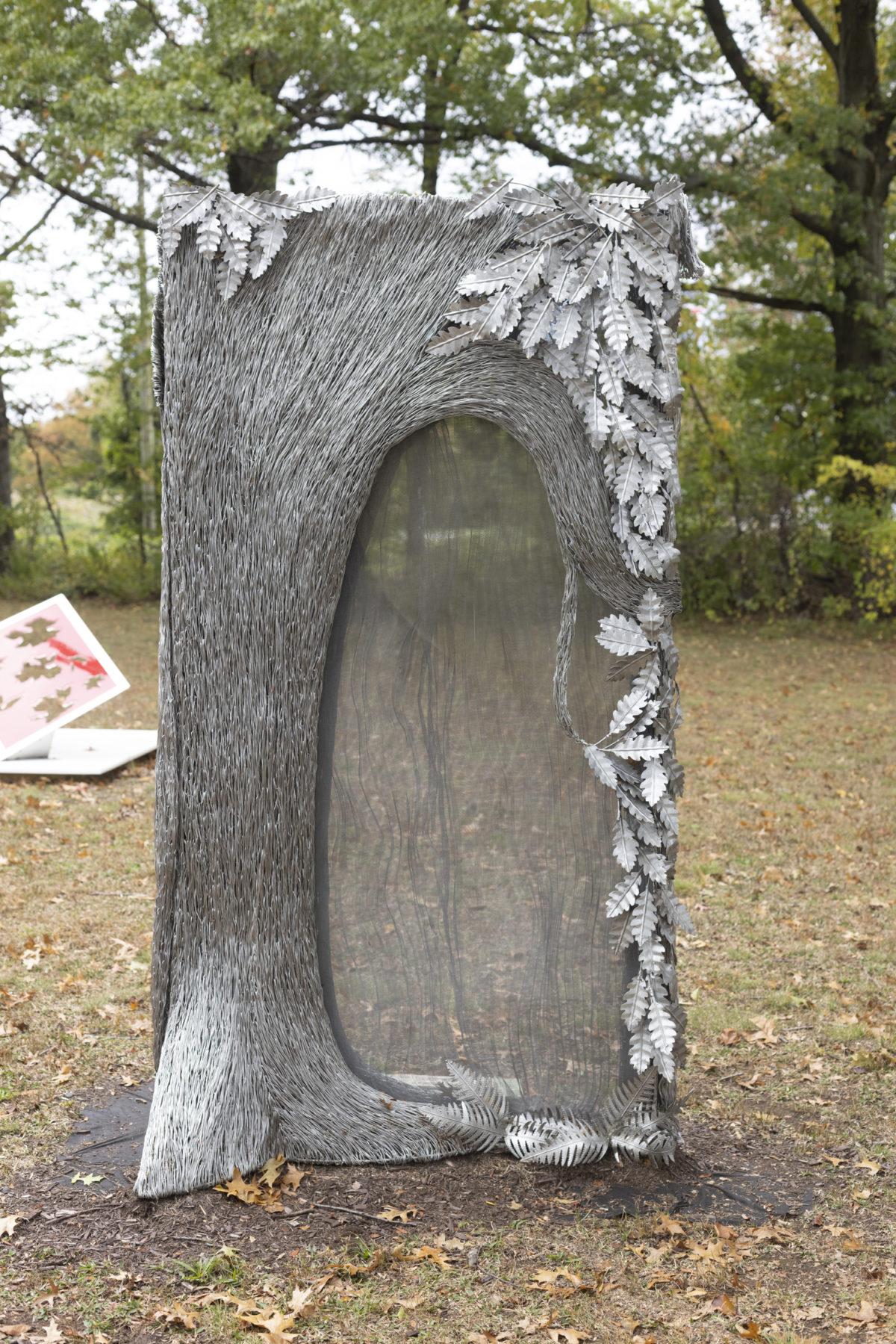
My sculpture Inside Out is a two-sided screen on which one side is the outside and the other is the inside. The center area of the sculpture is translucent aluminum screen. Are you looking from the outside in or looking from the inside out?
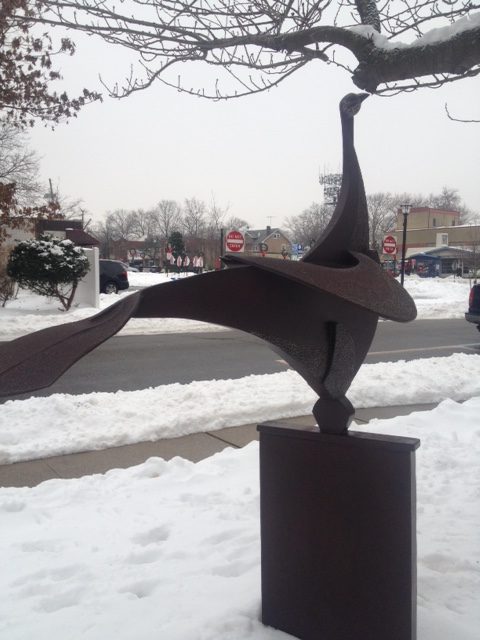
Morning Call by Justin Perlman is a lyrical bird form fashioned out of carbon steel with stainless steel accents. Perlman describes Morning Call as an “expression of a new day,” turning away from the past to begin something new and reach for the future

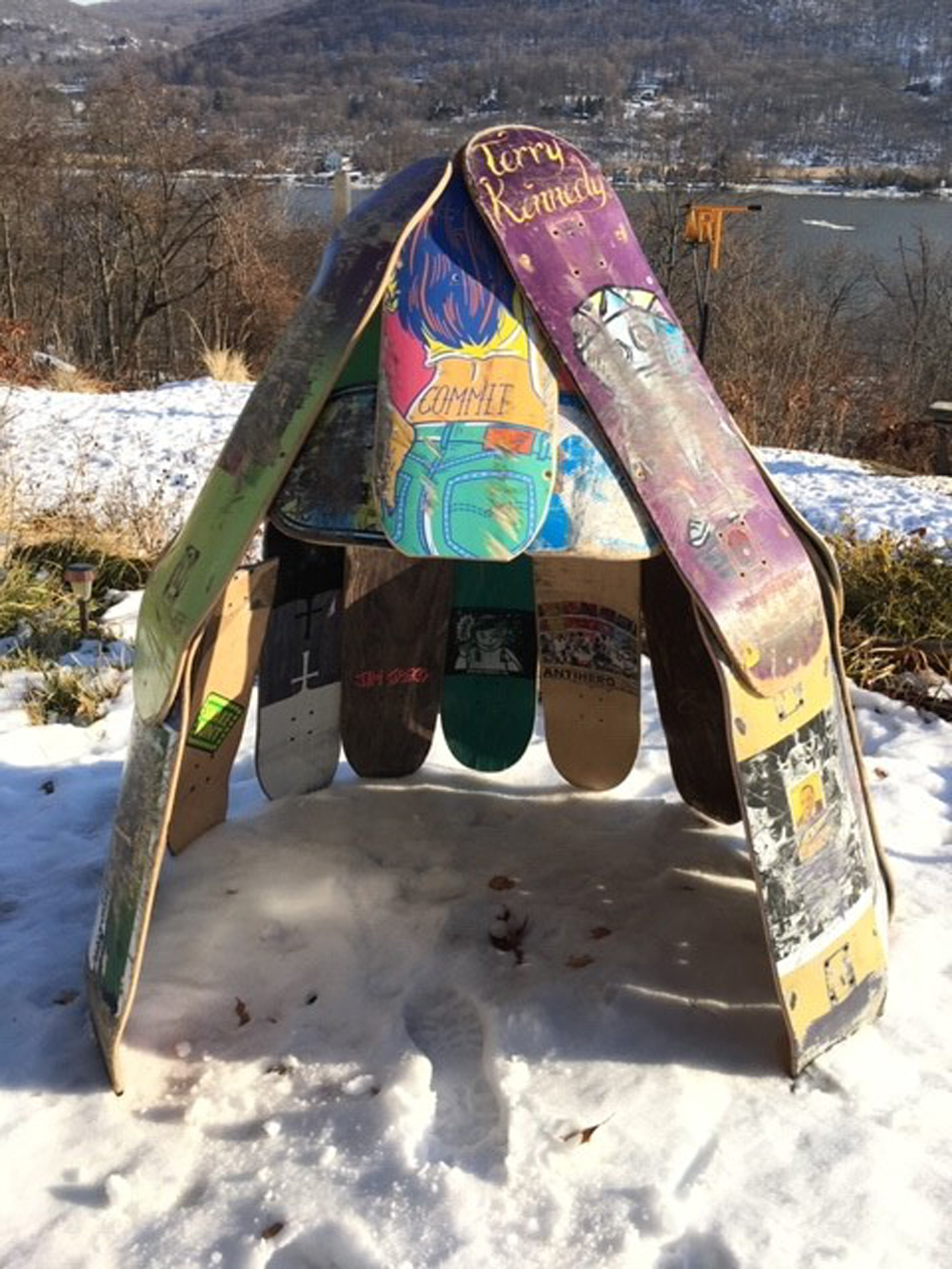
Making use of well worn skateboards- from their scuffed and shredded decks to the hardware that supports them. Betty Stafford’s art digs down through layers of rough use to find resilience, beauty and joy.
For more information, please visit bettystafford.com


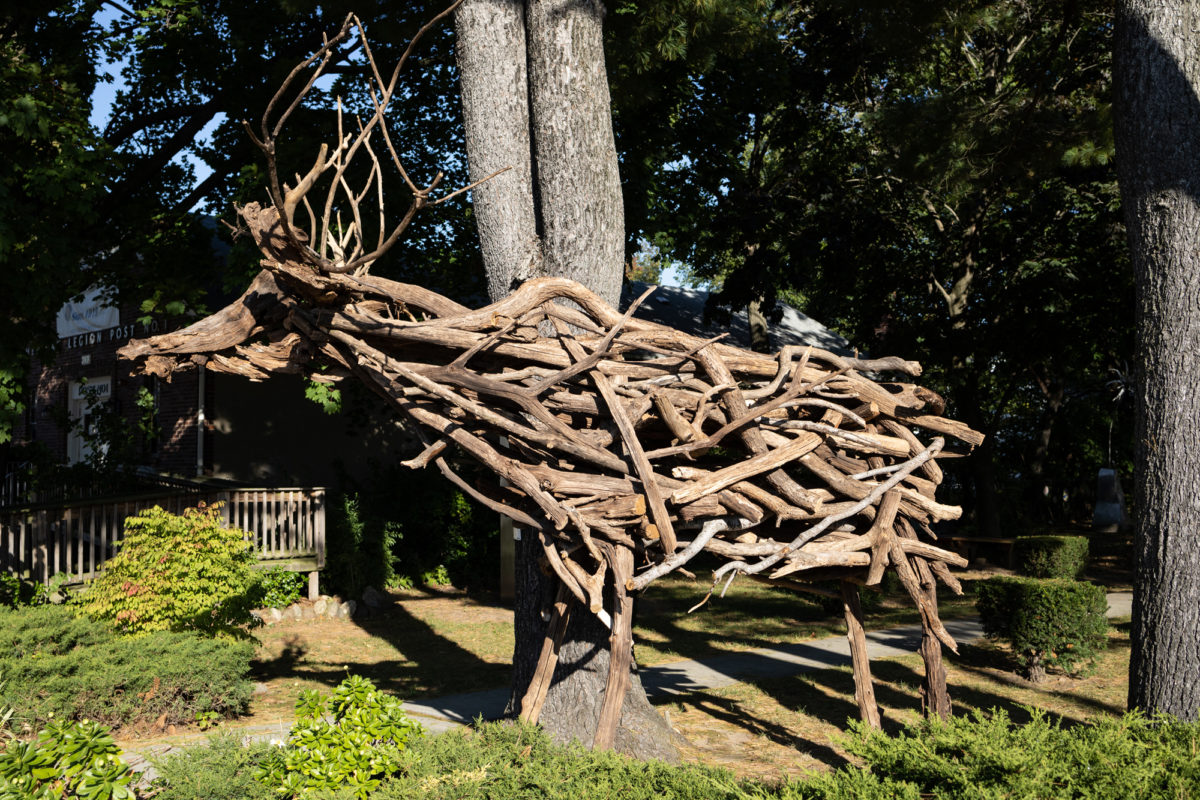
In the not too distant past the lower Hudson River Valley was almost completely covered by dense hardwood forests, which in turn provided a suitable habitat for the solitary and majestic moose, the largest herbivore in North America. The Leonia Moose is made of tree limbs from the immediate area, and built onsite. It encourages visitors to reflect on our precarious natural world and to imagine it restored.
For more information, visit albertobursztyn.com

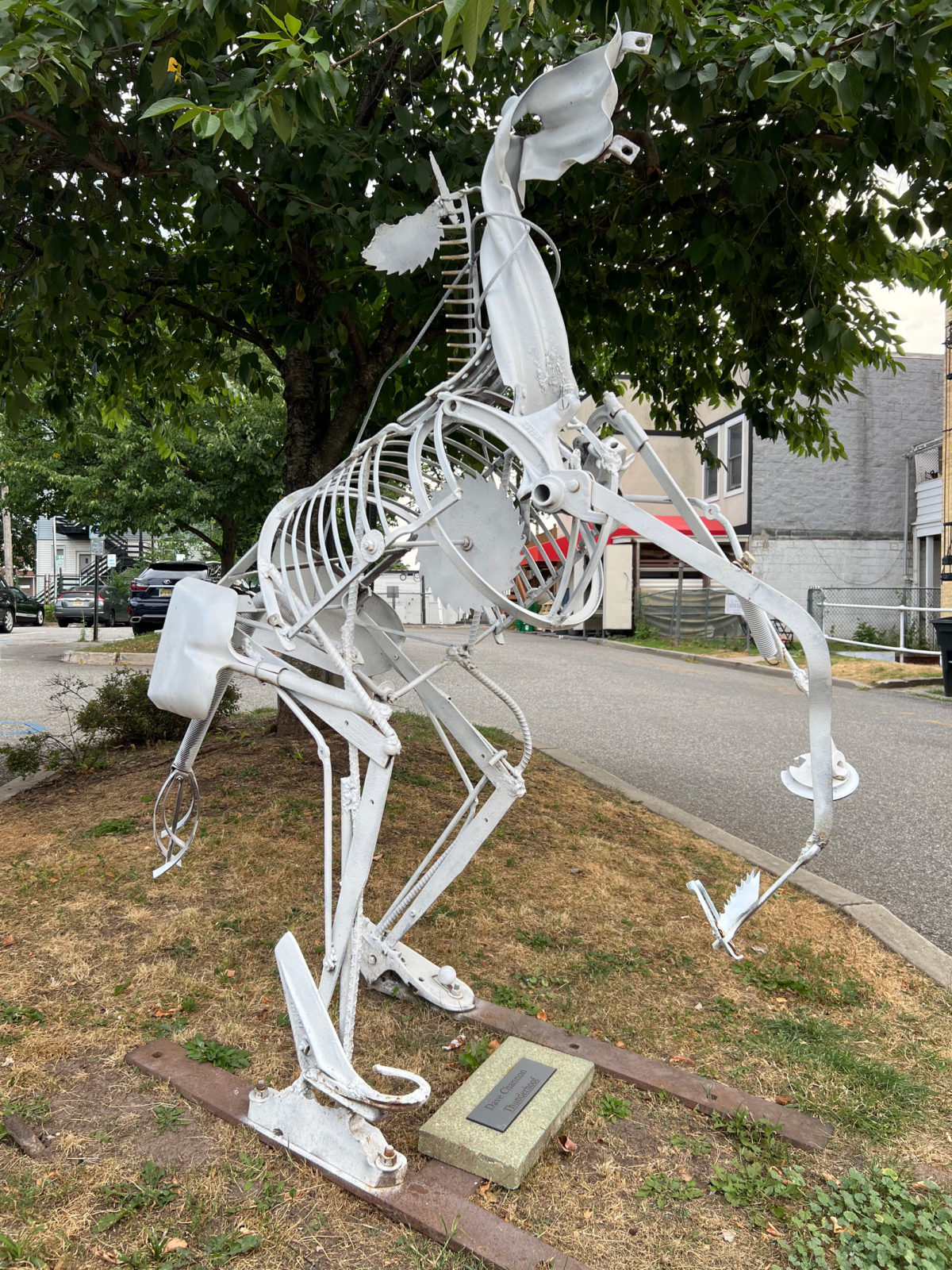
What is a “Scrapture”? An ecstatic non-static sculpture fashioned from scrap metal. Satyrical. Dynamicaly imbalanced engineering applied to antique steel implements with shapes that inspire visions. Recycled, repurposed, welded and bolted together. They move with the wind.
– Dave Channon
Dave Channon is a multi-media artist who began his career with an apprenticeship to Joseph Cornell when he was 17. He later collaborated with such important artists as Red Grooms, Peter Max, Keith Haring, Phillip Guston, Ralph Fasanella, Peter Max, Andy Warhol, Picasso, Ron English and Robert Indiana.
Channon’s first show was in 1979 at Franklin Furnace, an alternative art space in lower Manhattan. His sculpture has been favorably mentioned in the New York Times (Grace Glueck) the New Yorker, The Village Voice, Art in America, and New York magazine. During the 1990s, Channon focused on video art and had 250 inventive programs on Manhattan Cable TV, satellite broadcast, included in a Venice Biennale, and screened in museums, clubs and galleries. His paintings and sculptures have been exhibited in The New School, The Brooklyn Museum, Ft. Pierce Art Museum, and galleries in Manhattan and Brooklyn. His paintings have been used to illustrate ecological themes in Mother Earth News and other magazines and web venues.
Since moving to Shandaken in 1999, Channon has exhibited at the Rockefeller Stone Barns in Westchester, the Catskill Mountain Foundation Fine Arts Gallery in Hunter and the Erpf Gallery at the Catskill Center. His sculptures have been shown at Wards Island and Governors Island in NYC, Collaborative Concepts outdoor sculpture show in Garrison, NY, at 49A Sculpture Park at the Galli-Curci Mansion in Highmount and the public art park at the Catskill Interpretive Center in Mt. Tremper, NY. His work has been in three Kingston Biennials, CCAN outdoor shows in Red Hook, NY and North Bennington Vermont, and in the Westbeth Gallery in NYC. Channon has exhibited in the 4th and 5th Wilderstein Sculpture Biennials. Visit Channon’s new sculpture installations at Rail Explorers Train Station next to the Emerson Resort, and now at the Woodstock Art Exchange on Rt 28.
For more information, visit esopuscreek.com/
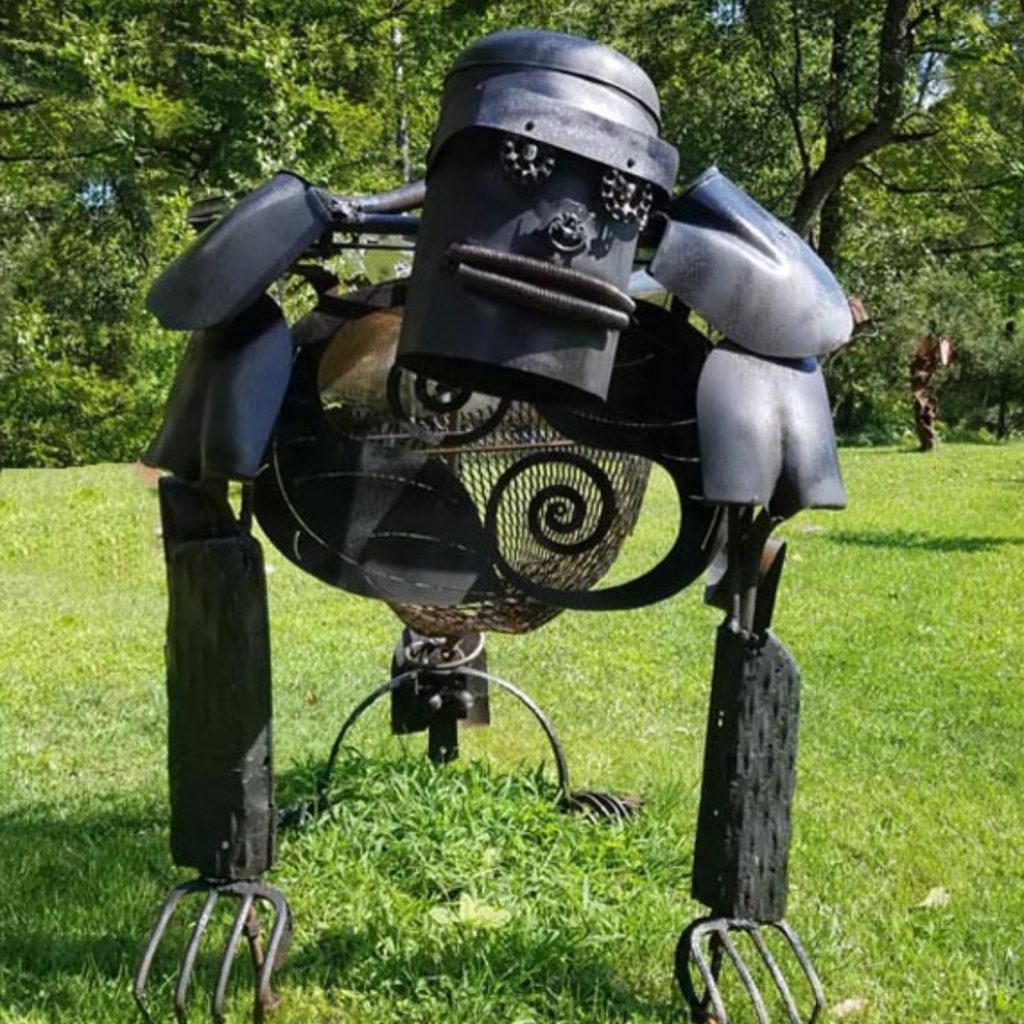
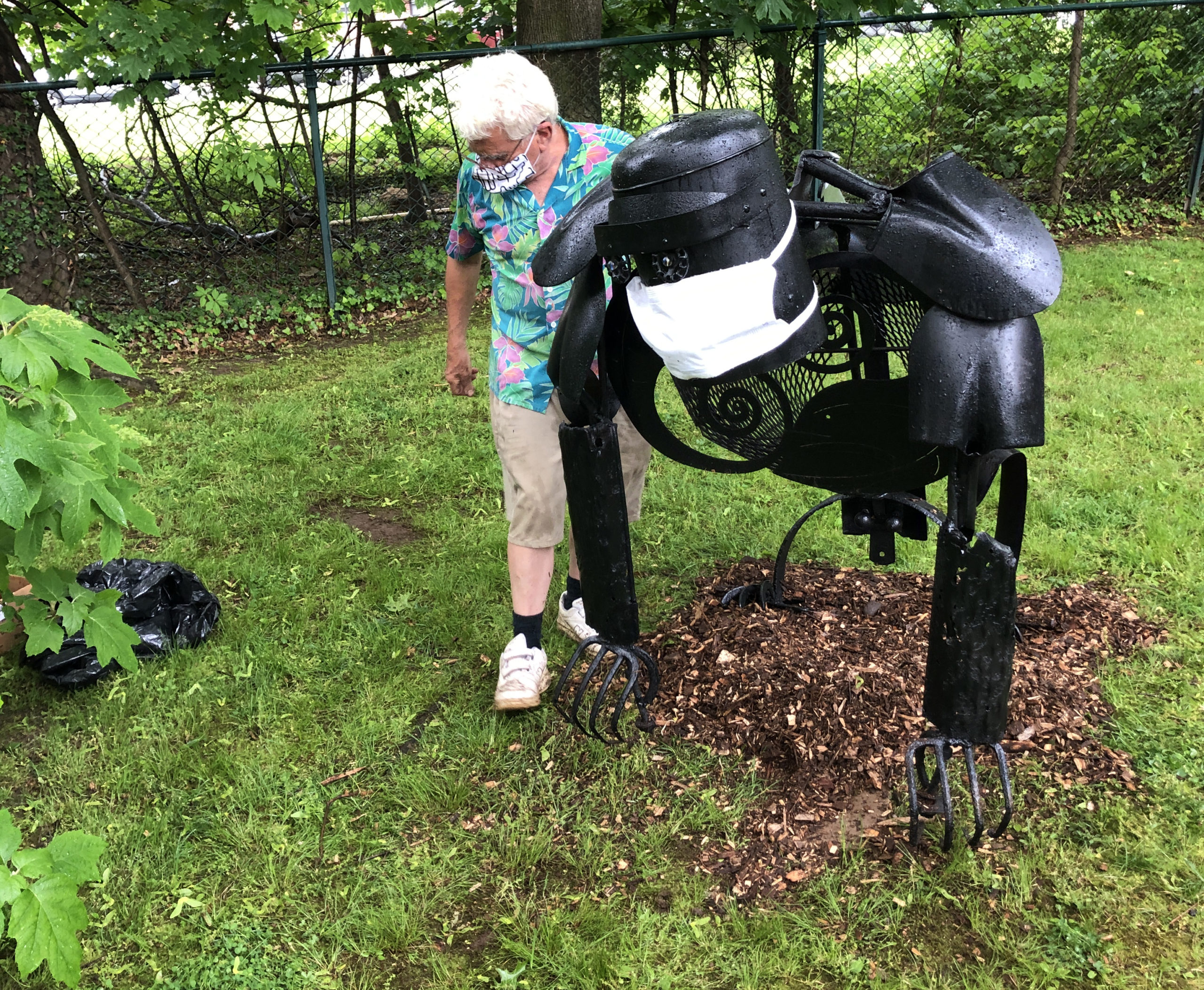
Read Dave’s article that mentions the sculpture in Leonia: Public Art in the Age of Plague
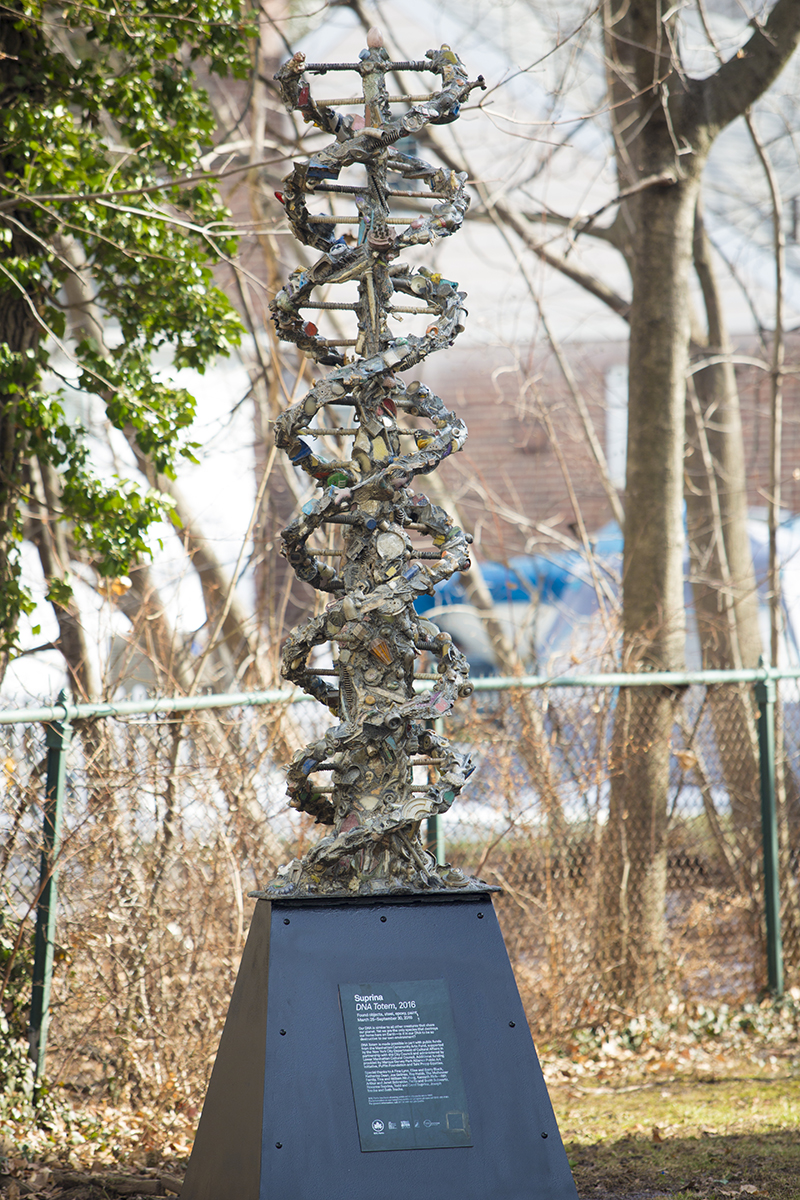


“Creating art is a combination of incredibly intense and sublime moments, none of which you control. It’s my job to show up every day ready to work and while it can feel like slogging through deep mud with only a vague notion of the direction you are going – continuing to plod is necessary to end with a result that I would call art. It’s analogous to fishing… you do all the things you’re supposed to do, like get up really early, sit quietly on the river’s edge, watch the water’s surface and with a leap of faith – cast your line. Once you have done all this, it’s up to the gods whether you catch a fish or a tire. If you’re good at your sport, you may be able to ‘feel’ what you’re coming up with, hence the Daimones. But a large part of the process is ‘doing the work’ and taking a leap of faith.
I often say- I’m not strong or courageous, but I don’t mind climbing out on a limb. In some strange way I’m comfortable there.” – Suprina
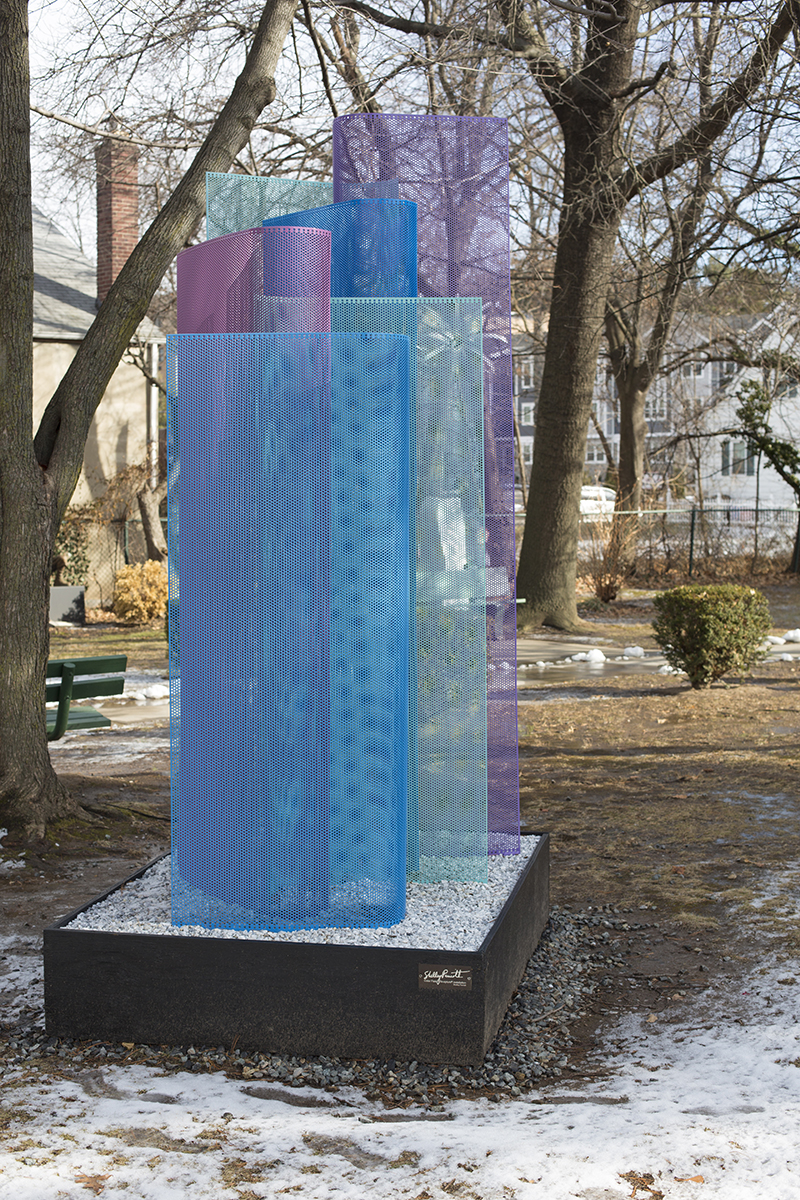
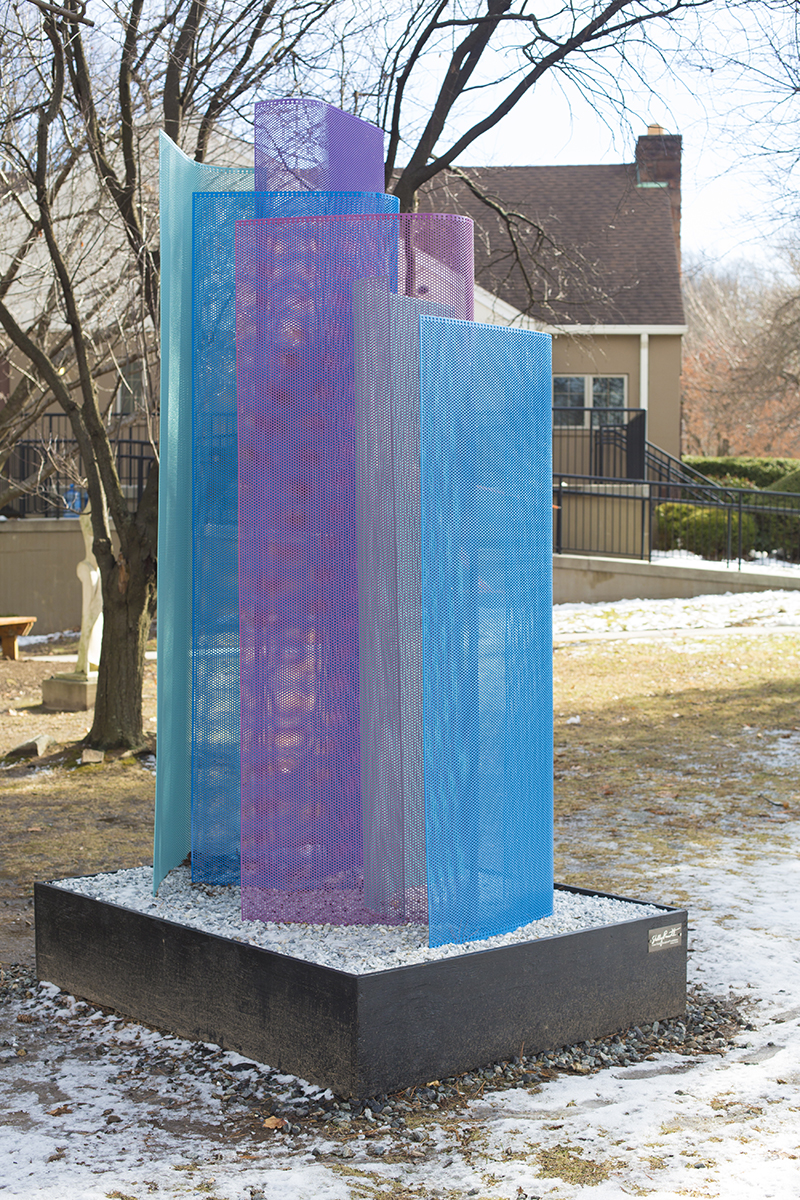

“Visually and conceptually, Color Field Sculpture® installations simultaneously present a dichotomy and an integration between the corporeal and the intangible – our physical and spiritual aspects. Monumental in size and visual impact, yet illusory, transparent layers play in the changing light to describe: material / immaterial, being / non – being, and the transitory nature of form.
From miniature interior wall pieces to large-scale installations, Parriott’s concept begins with our passage through existence: “existence is the medium through which every aspect of being is transformed.” Overlapping layers of experience translate into sheer sculptural layers that interact with each other, the participant, and the environment.
Largest scale site-specific configurations invite viewers to enter into and move through the sculpture – transitioning through time, space, prismatic patterns of color, blended tints, and optical illusions.
We question our conditioned perceptions and what seems to be, changes.
Color Field Sculpture® Installations Transform Space
Perforated heavy gauge aluminum is rolled, bent or folded by powerful presses as the sculptural concept emerges.
Permanent powder coated color is electrostatically applied to all components.
In a process of welding the artist’s vision to technical necessities, industrial materials are transformed from ordinary “workaday” existence into lyrical multi-dimensional expanses that immerse the viewer in vibrant fields of color.
As light passes through the transparency of the sculpture, the atmosphere shifts; shapes that at first glance appear to be solid and corporeal now elude definition. Mysterious shimmering nuances seem to appear/disappear, and take on an airy quality not usually associated with structurally sound large-scale sculpture.
Created in any size, shape or palette, indoors or out, suspended or anchored, varying hues enhance public spaces, interiors, landscapes, cityscapes, and private gardens – redefining the environment into a canvas of unlimited dimensions bounded only by the specifics of the site.”
– Shelley Parriott
For more information, please visit colorfieldsculpture.com
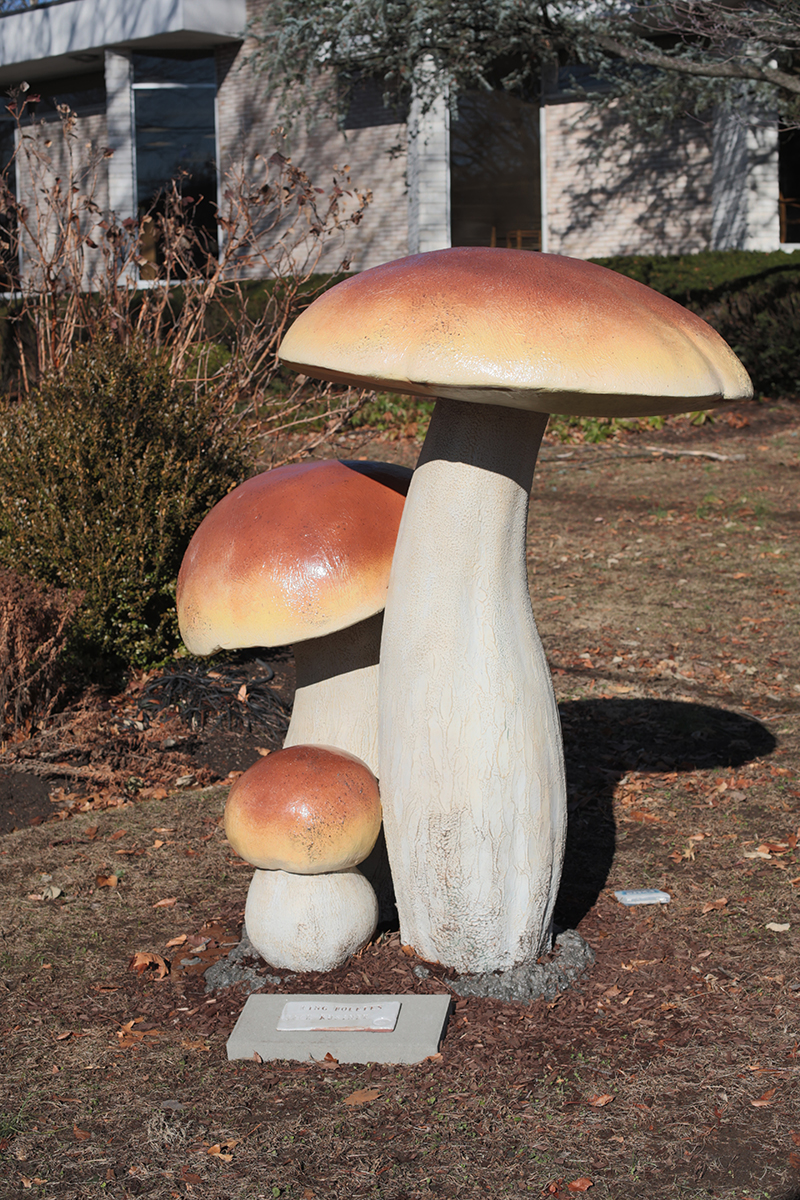
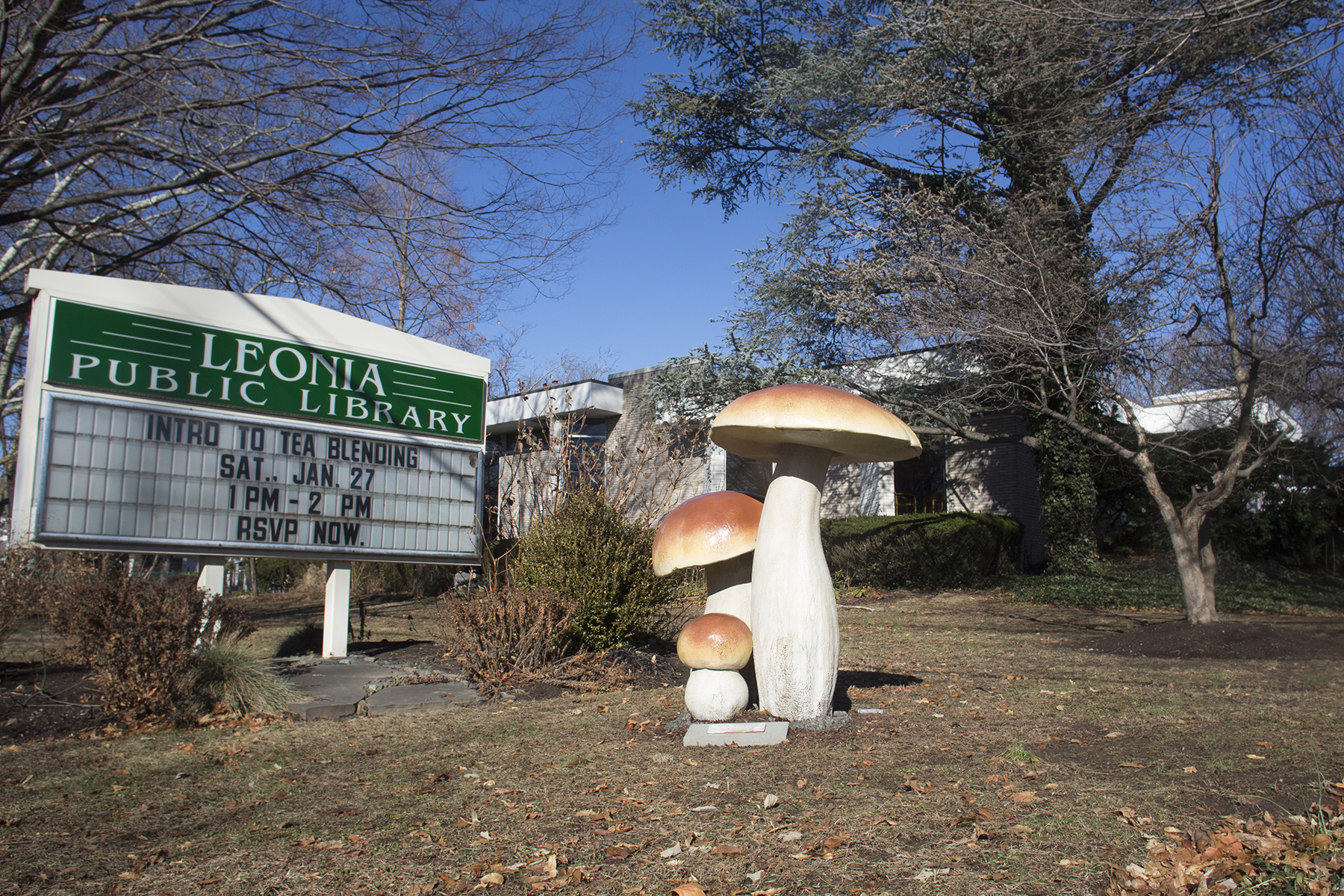
Large scale group of mushrooms, foam coated with fiberglass. Installed on the front lawn of the Leonia Library. More information coming soon.
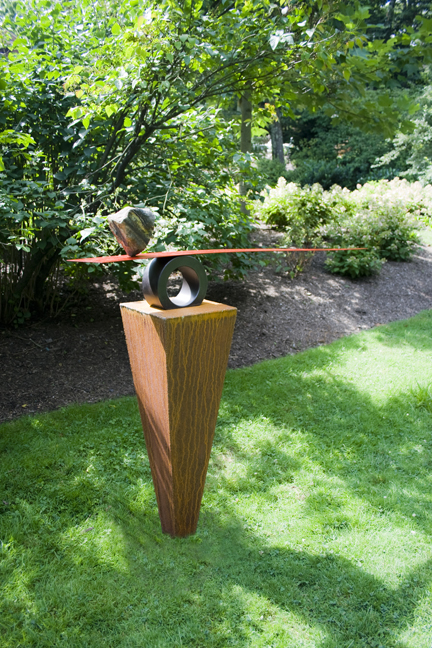
“I am drawn to working in the six elements of stone, metal, wood, light, ice and water. It gives me the ability to work intuitively. All possibilities can exist briefly before I impose parameters with regard to my emotional and intellectual contexts.” The undercurrents of natural decay, unity, duality, symmetry, space, time and dimension are at the heart of Tom’s creative energy. “I work seasonally, tracking the weather. Different temperatures demand independent responses to materials and approaches. Ice follows the freezing mark of winter, stone and steel the exterior work space of summer. Spring begins the search for materials and fall settles all debts, emotional, physical and intellectual. My work is my life and I thrive on long days. There is only the transcendence of the everyday. Cooking, friends, love becomes the sublime witness of doing. Process for me is the essence of my day.” – Tom Holmes
For more information, please visit tomholmes.com


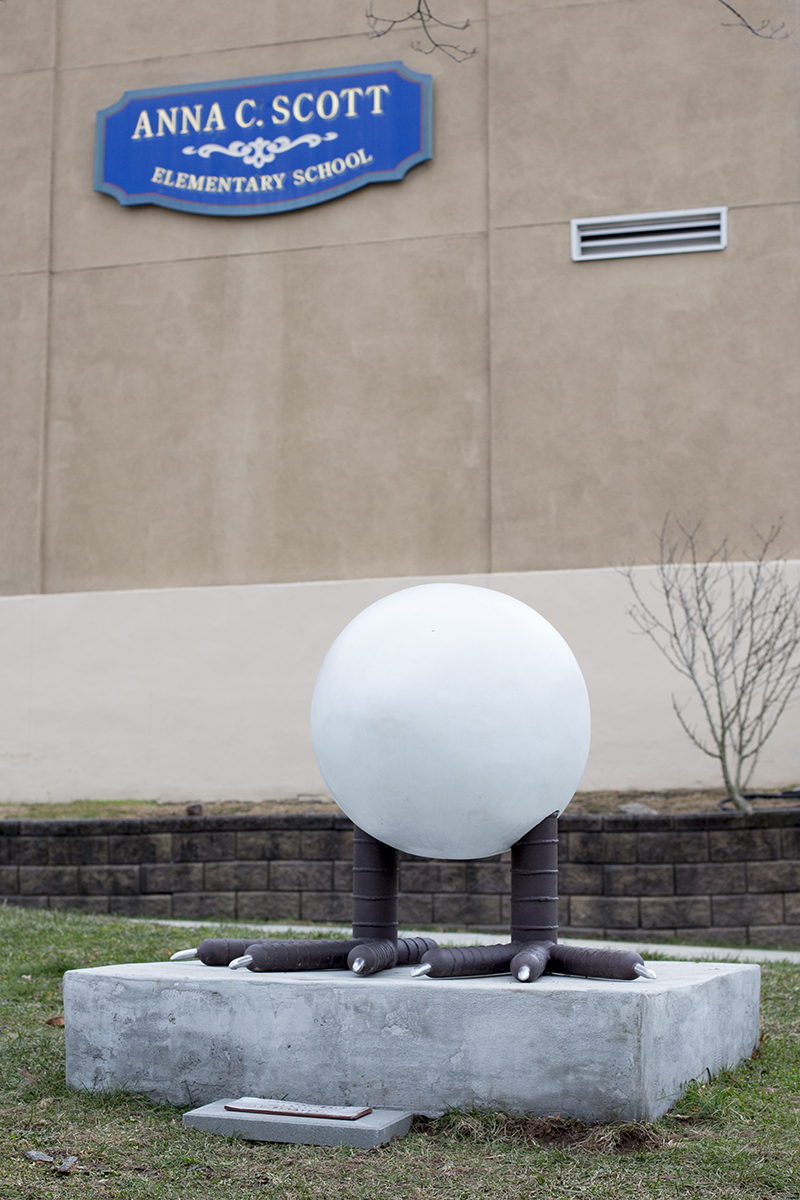
cement, stainless steel, paint, 2005
“In the never ending search for the meaning of life, the philosophical question of which came first, the chicken or the egg, suggests that a simple and definitive answer is at hand. Of course the simple answer is evasive and only generates more debate. It is generally assumed that the solution lies within a choice between one or the other proposed answers. I propose that the answer is not a matter of limited choice. The nature of life and art is ever expanding. Growth requires exploration into the undefined. Therefore, I would answer that it is not a choice between the chicken and the egg but rather a third, unspoken choice which is creation. When untapped knowledge (the egg) combines with inspired motivation (the feet) the possibilities are endless and the question of which came first is irrelevant. Creativity is life.” – Ed Benavente


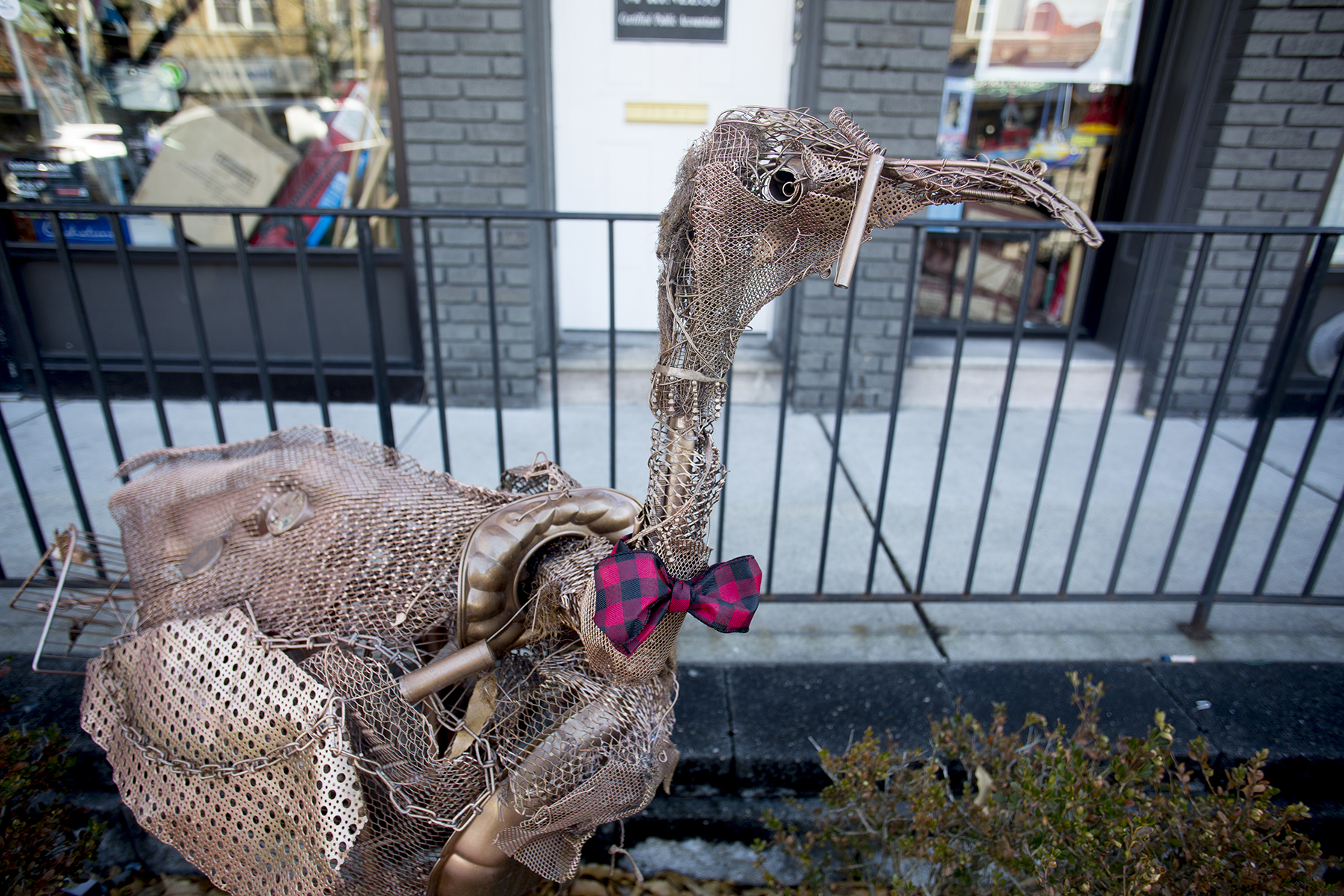

Two life-sized turkeys made of found metal objects. Installed in front of Moore’s Hardware on Broad Avenue.
“Animal forms are central to my work. I find the commonalities of our coexistence a great mystery and comfort. Animals often help us visualize the paradoxes and pathos of our own lives, of our beliefs and philosophies; they reintroduce us to beauty daily, they remind us of fierceness and fragility, they are our boon companions both on earth and on the vast steppes of metaphysics and imagination.” – Hildreth Potts
For more information, visit hildrethpotts.org
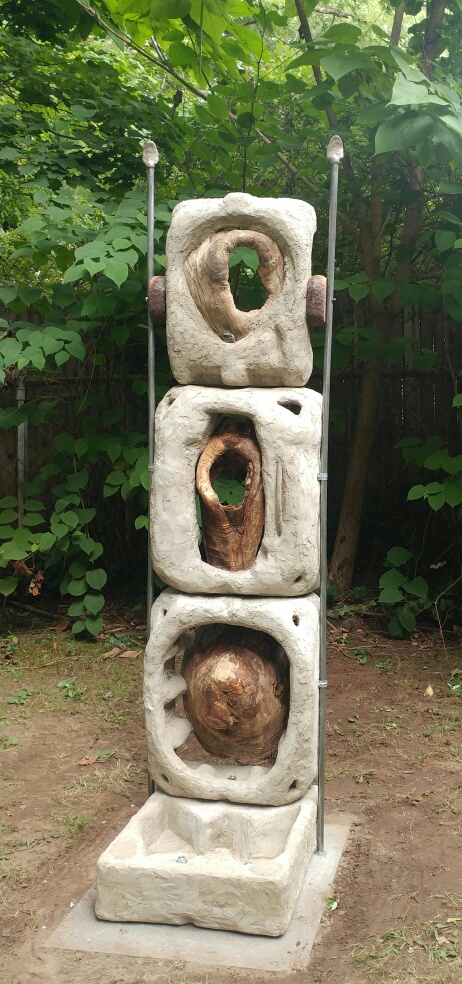
“The totem, Ode to Ninja, is part of a body of work conceived to serve a variety of purposes in the future, and to illuminate the dangers of our current situation. In the mythology of this project, it represents the worship of the Ninja, a creature revered for its endurance, especially during the devastating flooding of the “Tidal Decade”. Ode to Ninja symbolizes my belief in the spiritual as an essential need in art and life.”
– Janice Mauro
For more information, please visit goodwoodstudio.com

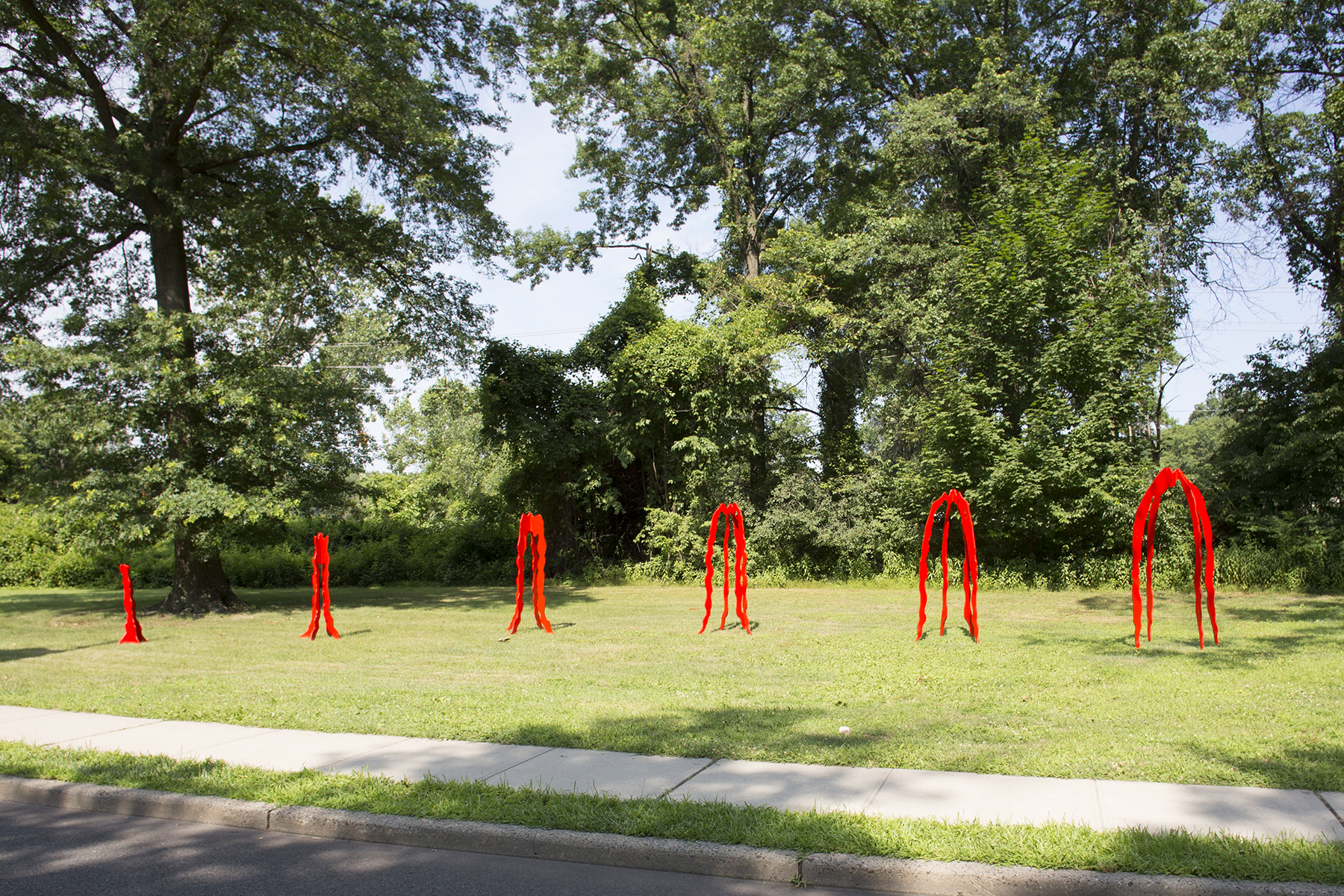
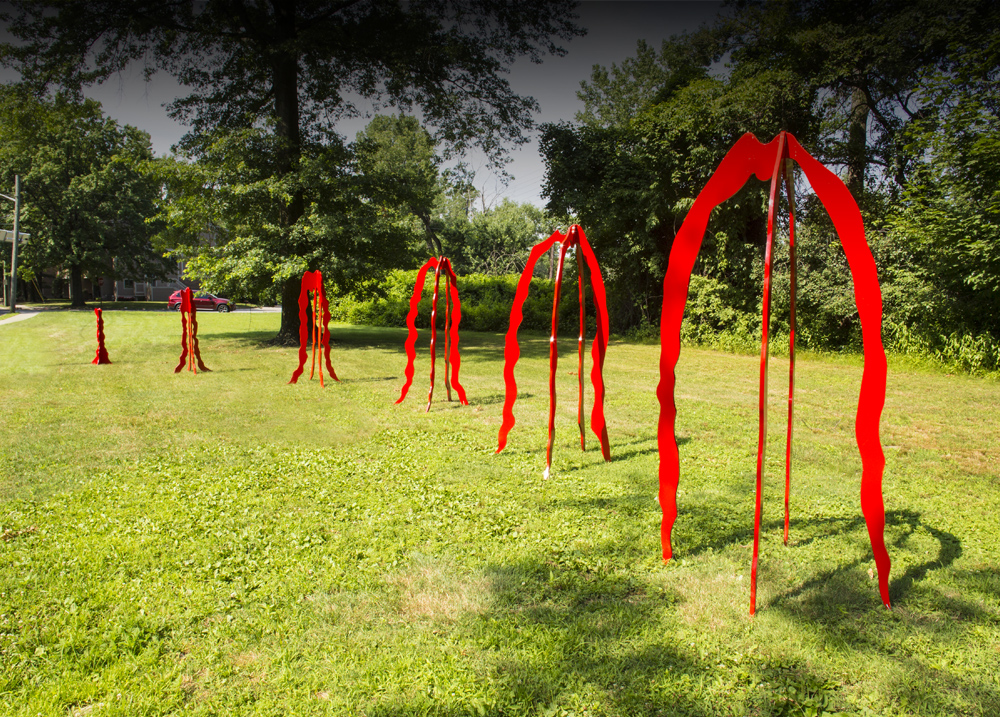
“Evolution #1-6 is one in a series of sculptures fabricated in powder coated aluminum. I have been a builder and an artist for over thirty-five years. These works combine my history of working in three dimensions with my intense love of color and form. Each of the pieces in Evolution #1-6 contains the exact shape of its succeeding piece. In other words, each separate sculpture evolves from its previous companion. When assembled together they resemble a creature arising from the primordial ooze.”
– R. Douglass Rice
R. Douglass Rice, who has had studios in New York City and Stonington, Connecticut, has exhibited in the National Arts Club in New York, Mystic Museum of Art, Farrah Damji Galleries in New York and East Hampton, Beef Gallery in San Francisco, Avondale Arts Center in Avondale, RI, and others. He studied at Stanford University, from which he graduated with a BA, the Mendocino Arts Center, and the School of Visual Arts in New York City. He currently lives in Stonington, CT.
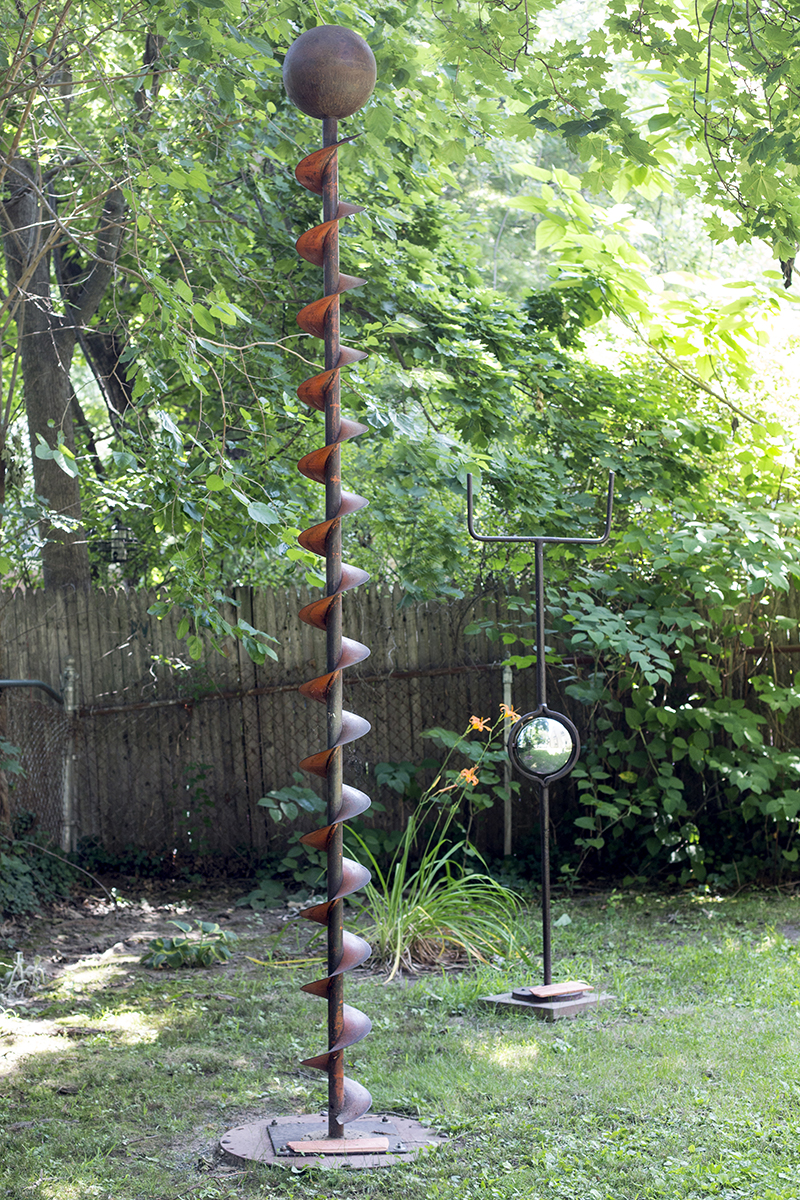
“I salvage scrap materials and obsolete objects, repurposing and recomposing them as works of art, while combining previously unrelated elements in unusual and unexpected ways. My sculptures evoke the former times, places, lives, unique character, and embedded energy of their source materials. I tell their stories, as I explore and mediate the essential relationship between their form and content.
Ranging in size from the intimate to large scale installations, my sculptures are displayed indoors and out, often in spaces and settings of my own design. Individual works, series, and commissions are included in many private collections and outdoor public exhibitions.”
– Conrad Levenson
For more information, please visit conradlevenson.com
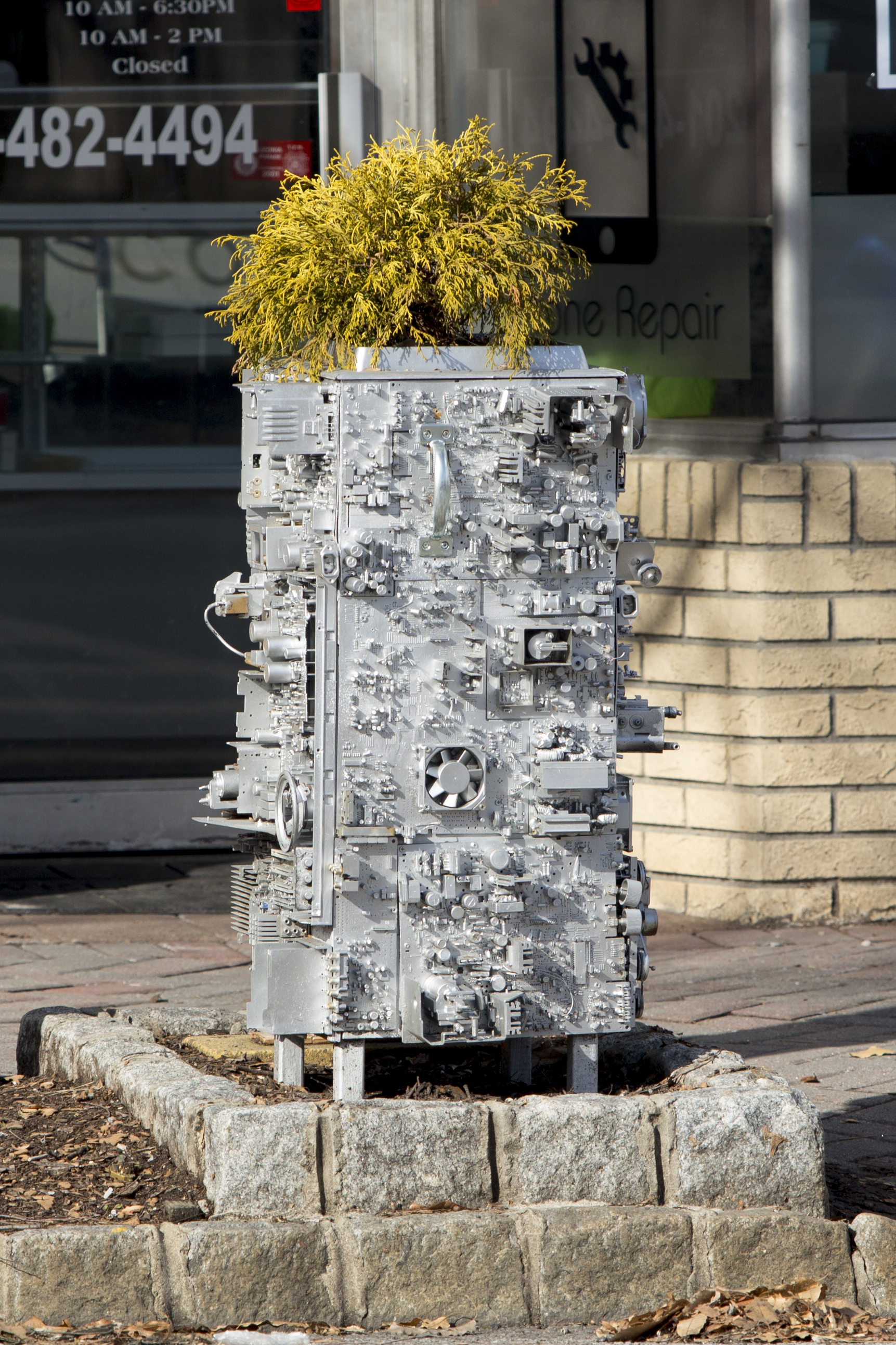

Charles Palminteri is a bold, abstract painter of the “action” school. Many of his works are purchased by architects for office buildings and executive homes in New Jersey, New York, Connecticut and Florida. Mr. Palminteri has exhibited at Foote Cone & Belding in Manhattan, rocheBobois in Estero, Florida, the Sweet Art Gallery in Naples, Florida, the Speak Easy Gallery in Boonton, New Jersey, and the George Segal Gallery at Montclair State University. Palminteri uses a variety of styles and approaches in an abstract expressionist framework. Some are large, gold patterns and shapes developed from Japanese Kanji and Hiragana calligraphy.
The start contrast of these shapes in their background sets up a tension between the negative and positive areas that demand attention from the viewer.
In other works, Palminteri’s lines are soft and flowing. With a series of undercoatings, he achieves a luminosity of color and light. His shapes lead the viewer into a maze of dreams and lunacy. No matter how soft the lines and shapes, the overall message is strong and clear.
A graduate of the School of Visual Arts, Palminteri attended the Arts Students League and the Chinese School of Brushwork in New York City. Mr. Palminteri is also a well-known commercial artist and graphic designer whose clients include many Fortune 500 companies.
For more information, please visit artetc.net


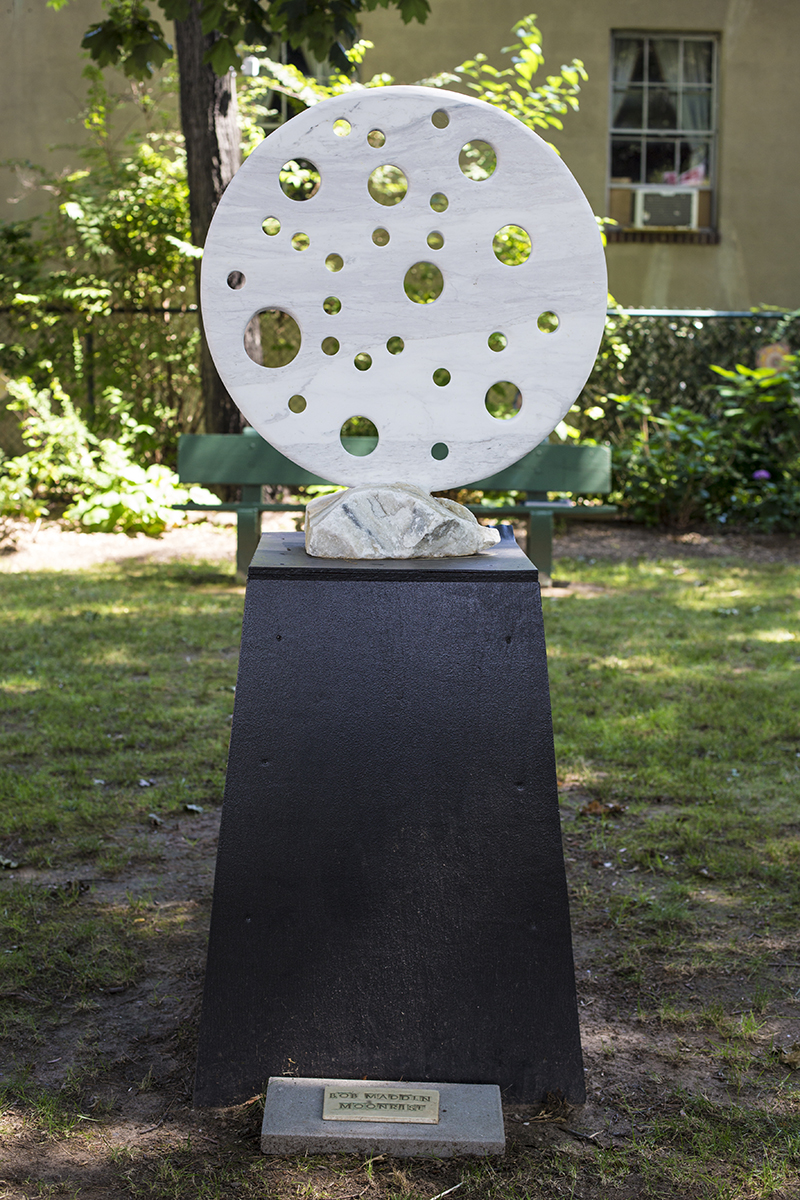
“Stone sculpture allows me to speak in a universal language. Creating a stone representation of an idea, a concept, or a feeling for the viewer to interpret through their own experiences begins the unspoken dialog. Stone is my choice of medium because it is perceived as a hard, cold, and unfeeling material. But when stone is presented as a soft or complicated shape, a person will react with amusement and amazement that opens their mind to new possibilities and prompts them to reexamine their views on the broader subject matter.
Generally my work will alternate between two major themes; works which explore our place in the universe, concepts of space, time, destiny, and chance, and the second major theme of interpersonal relationships and the connections that bind people together. Keeping in mind the quote from Socrates, “The unexamined life is not worth living”, I strive to develop works which ask the viewer to look beyond themselves and see how they relate to the rest of humanity and where they fit in a larger universe. The underlying tone of any specific work may be designed to provoke amusement or serious reflection, but it’s during those moments that the mind opens up to new perspectives. This is the objective of my work.
Carving stone has been my passion for over 30 years. I think of carving stone as a negotiation with the universe; what I want the piece to look like vs. what the stone will allow me to do. It’s humbling to realize that the natural processes that create stone can take millions of years but if I’m impatient in my efforts I can destroy the natural beauty and character of the stone with a single careless hammer strike.” – Bob Madden
For more information, please visit rockandasoftplace.com.

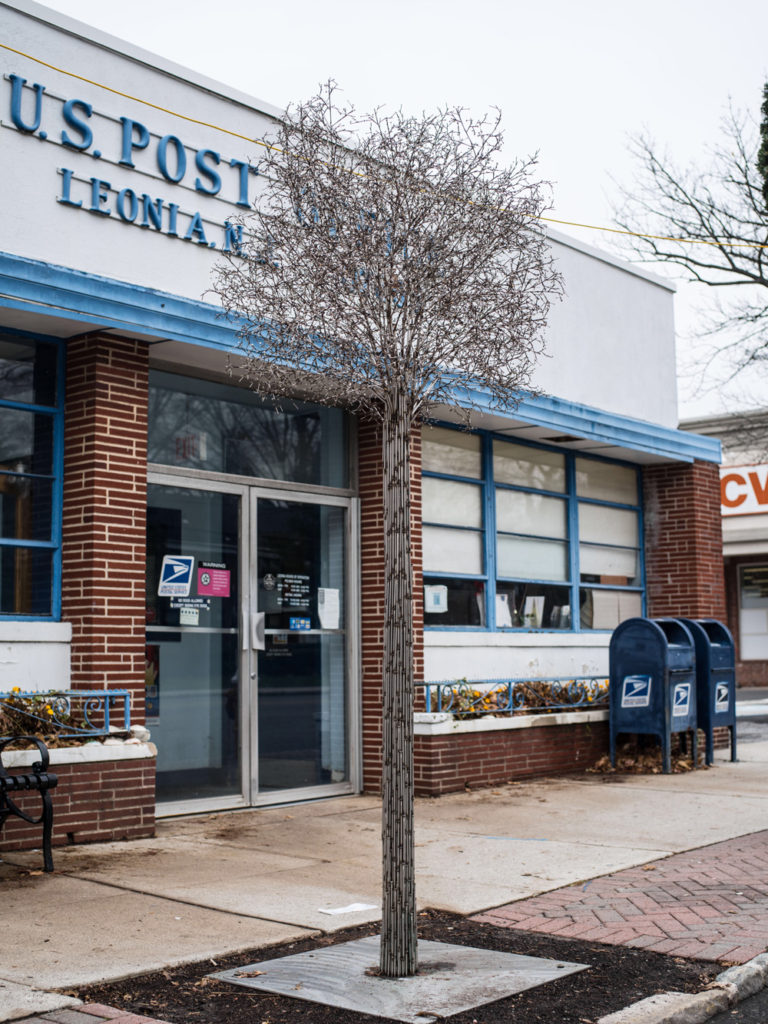
“Nails are very important tools in terms of structure and stability. One nail by itself however can not hold too much together. Much of the time it is necessary for multiples to be used in unison. Each nail represents a person in my work. I use stainless steel nails for the clean and pure appearance. When each nail is welded to the ones next to it, it will visually have a bond specific to that set of nails. Every bond or weld is different which comes to represent the individual relationships between people on a grand scale. Each nail used differs in size from the ones next to it, below it, and above it in a way to simulate the variety found in nature and society. In this event when we take a step back we no longer see each individual nail, but one tree, one tree that encompasses thousands of smaller pieces each have their own bonds and relationships and ultimately play a much larger role maintaining stability and structure through their strength.” – Insun Kim
For more information, please visit insunkim.com.

“Over the course of my career I have been concerned with creating work that is drawn from elements found in nature, a and the mechanical world. My hope is to highlight the similarities and differences of our experiences in the world by creating a “false nature” or nature re-created .
I am interested in finding architectural order emerging from nature and translating that into sculpture. This examination of plant forms is a daily practice for me in the rural environment in which I live. I am amazed how their form and structure relates to man made objects oftentimes in terms of structure and the physical strength of the object.
My goal is to build pieces that are expressive, interesting and also have structural integrity and will withstand the elements.
I build sculpture with a degree of uncertainty and spontaneity. I see it as a conversation with the piece I am working on. I am very process oriented, and these pieces grow and evolve as I continue to work on them.” – Joe Chirchirillo


“Over the last 5 years I have been concerned with creating sculpture that is drawn from elements found in nature, architecture and mechanical world. Sometimes they strike me as parts of decaying buildings, other times as architectural order emerging from nature. There is an intentional vagueness about the visual imagery.
For me, sculpture is about creating what doesn’t exist as opposed to rendering what does. It is a conglomerate object created by someone who is having a conversation with the material and the world around them.
I build these sculptures by casting over steel structure into either molds or wet sand. There is a degree of uncertainty and spontaneity in each casting event. I am very process oriented and these pieces grow and evolve as I continue to work on them.” – Joe Chirchirillo


These sculptures are located on the corner off Fort Lee road and Station Parkway. Ewerdt Hilgemann, distinguished Amsterdam-based German artist is currently showing in Leonia, N.J. The sculptures, ranging in size from 8 to 20 feet in height, were created specially for a Park Avenue, New York City installation using a unique vacuum process, which “implodes” geometric shapes causing the material to deform according to natural laws. Hilgemann developed his method in the early 1980s after experimenting with white wooden wall pieces that captured light, influenced by ZERO movement. Hilgemann’s “implosion” process begins by fabricating perfect, geometrically pure stainless steel forms, which are meticulously welded and polished to satin gloss. After this part of the process is complete, the artist slowly pulls the air out with a vacuum pump, putting the natural atmospheric pressure to sculptural use and collapsing the forms into their final shape. In a delicate balance of planning and chance each piece acquires individual character demonstrating unexpected and striking possibilities of the material.
“To me the implosion represents the inward spiral of energy to reach the core and mystery of matter, the ultimate beauty of creation,” says Hilgemann.
Ewerdt Hilgemann (1938) was born in Witten, Germany and after briefly studying at the Westfälische Wilhelms-University in Münster, he attended Werkkunstschule and the University of Saarland in Saarbrücken. In the 1960’s he had residencies at Kätelhöhn Printers in Wamel, Asterstein in Koblenz and Halfmannshof in Gelsenkirchen, Western Germany, and started to exhibit his work across Europe before moving to Gorinchem, The Netherlands; and has had public installations from Busan, Korea to the City of West Hollywood, CA. Since 1984 the artist lives and works in Amsterdam.
For more information please visit www.hilgemann.nl
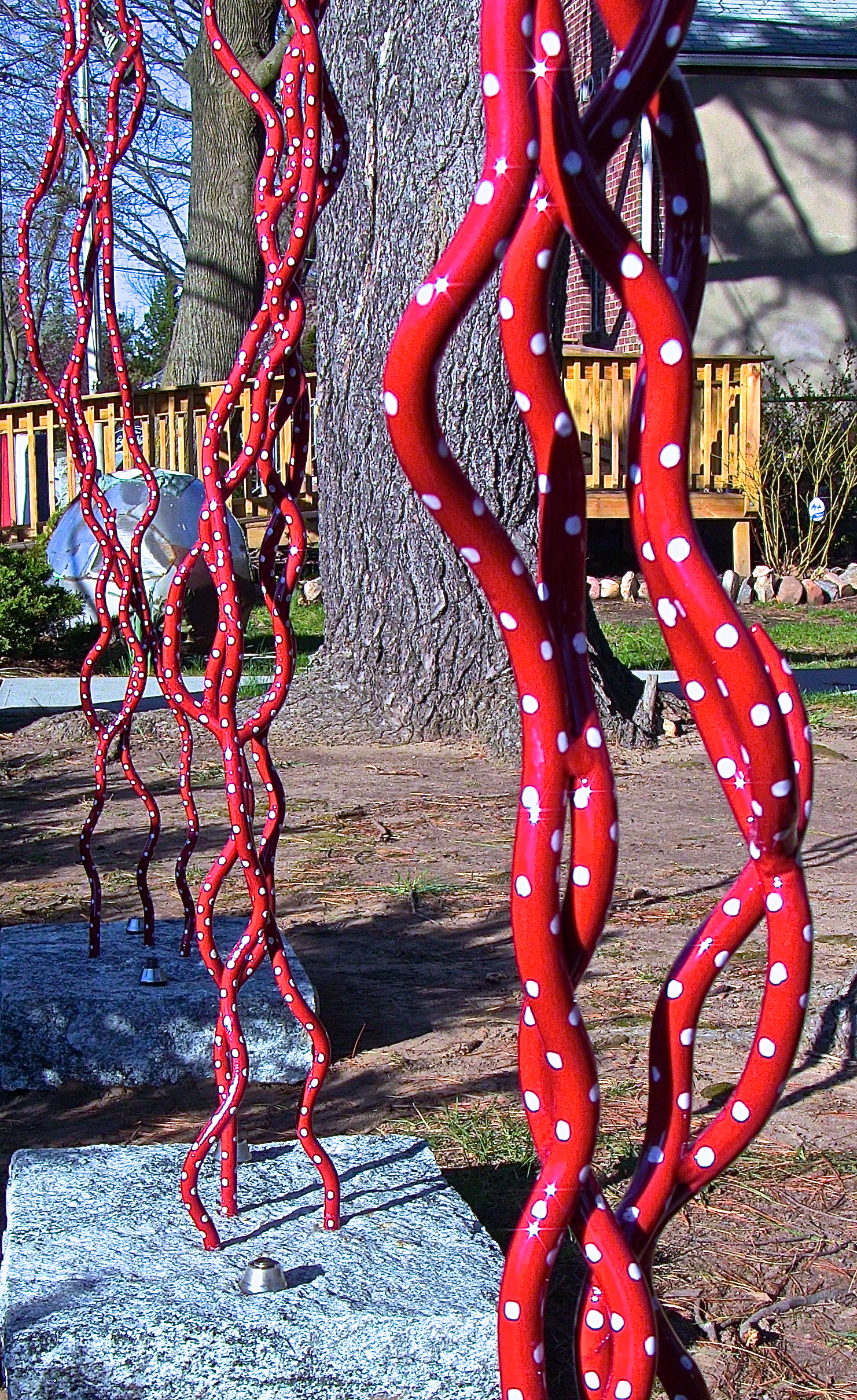
This sculpture is located in the sculpture garden. Metal sculptor and multi-media artist Mark Attebery worked previously in stained glass, with over one hundred glass works installed throughout California. In addition to visual arts he’s had a busy career as a composer. He has received numerous music commissions from dance companies, including the Oakland Ballet & Malashock Dance Co. Mark received awards from the San Diego Arts Commission, the Ann & Gordon Getty Foundation and Meet the Composer Inc. The American Ceramic Society included Mark’s recordings of experimental clay musical instruments in a CD & Book titled From Mud to Music. He teaches at Ethical Culture Fieldston School in New York. Mark fabricates his forged and welded steel sculptures in his Nyack, New York studio. His work is exhibited throughout the United States.
Artist Statement: As a sculptor I’m interested in depicting beauty, stillness and most of all a life energy coursing through metal. Flowing movement and sensuous growth observed in nature inspire recent sculptural work. While primarily abstract, these steel sculptures suggest natural phenomena and living organisms inspired by both botany and astronomy. Graceful gestures are forged using traditional blacksmithing, then welded and finished with patinas, electro-plating, automotive paint or powder coating. These are personal choreographic gestures in metal, aiming to capture moments of elemental grace observed in the natural world.
For more information please visit MarkAttebery.com

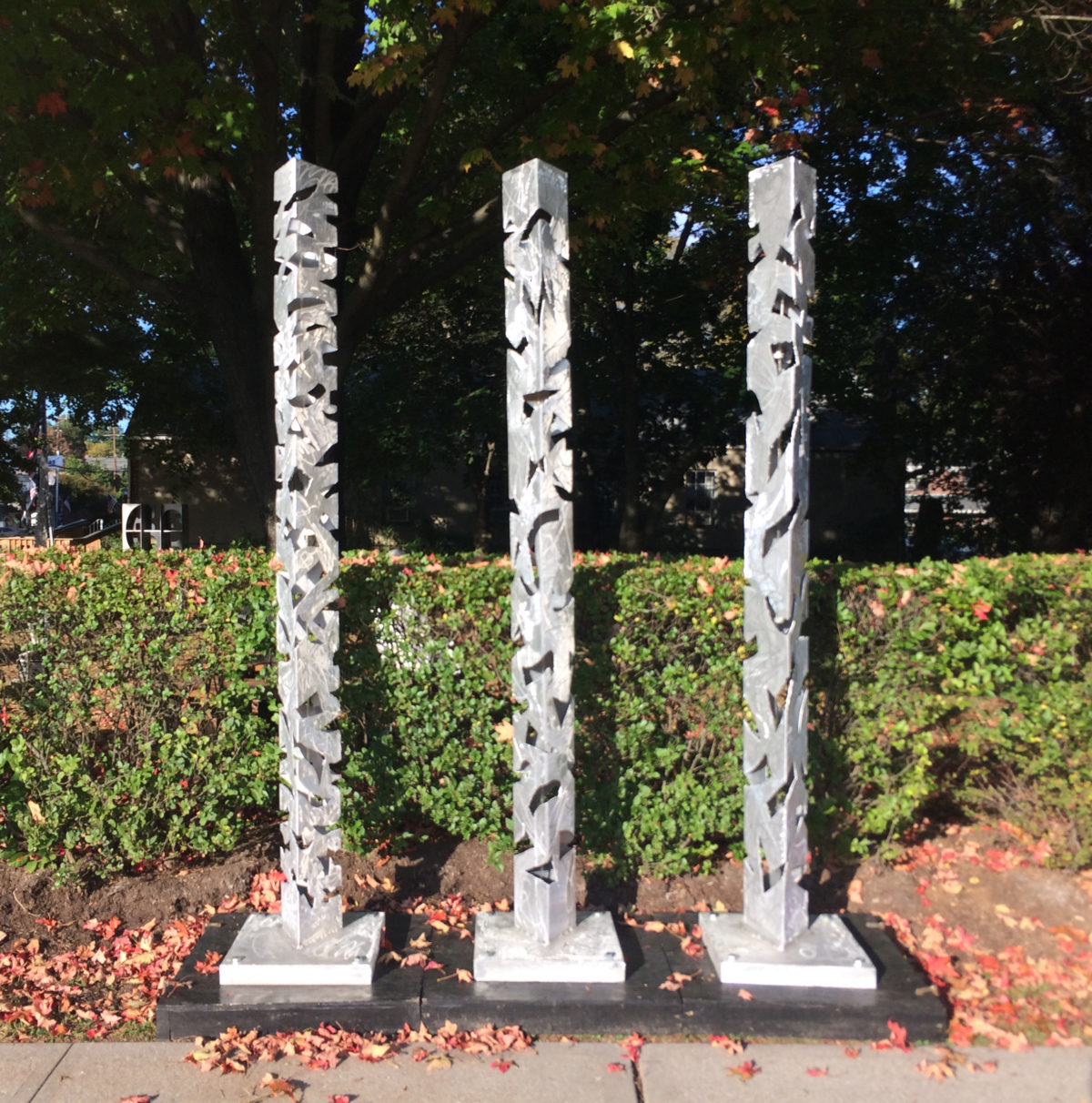
My art is first informed by the humanfigure, its essential vertical presentation with a focus on unique but relatedfrontal and rear views, and the gestalt of interconnected shapes that are bothlinear and volumetric. It is secondarily informed by totem poles of the NativeAmericans of the Pacific Northwest and other tribal cultures from around theworld, with their stacked and interconnected elements that may represent keyfigures or concepts in their myths and legends, combined to “tell a tale” orremind of basic cultural tenets. Though my sculptures do not represent anyspecific events, I imagine my pieces as abstract tales both of personal eventsor generally themes of human experience.
The pieces develop from gesturalsketches based on this visual language of interconnected forms merging anddiverging usually along a vertical axis. Most recently I have worked in forgedsteel which has fostered new gestural elements that this material inspires.
For more information please visit http://www.absolutearts.com/portfolios/d/dslombardo/

“I want my sculpture to create and activate space with a sense of enrichment. The value that I look for in my work is that it references the environment, giving it the presence of being an important entrance way that encourages a personal path that inspires the way we meet the day.”
– Richard Pitts

Previously instaled at the corner of Woodridge Place and Broad Avenue across from the sculpture garden, currently no longer in Leonia, for more informaton visit the artists website listed below.
“This group of sculptures was completed over a period of seven years. Through the process of fabricating forms in aluminum and completing many smaller sculptures, the larger works took shape. Most works started with brushed aluminum surface, later to be powder coated, a hard and weather-proof finish. Each piece was titled after its surface color.
At first each sculpture was made as an independent work. It was later, after they had been painted that I saw the whole group as one piece. The word “Crayons” was a serendipitous title that I liked because the colors of each sculpture reminded me of a box of crayons.
Crayons are one of the first tools we receive that encourages visual thinking.
These works are meant to activate the imagination, which is the main tool of our destiny.”
– Richard Pitts
For more information please visit www.richardpittssculpture.com
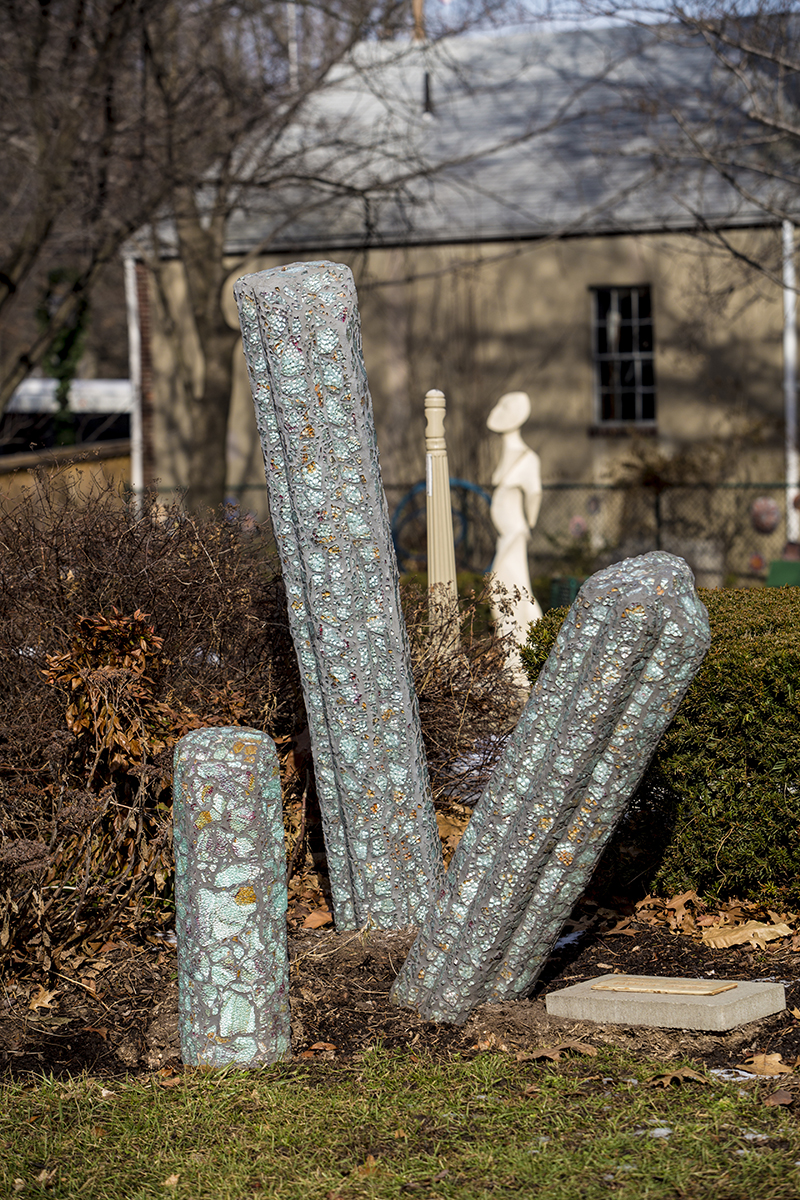
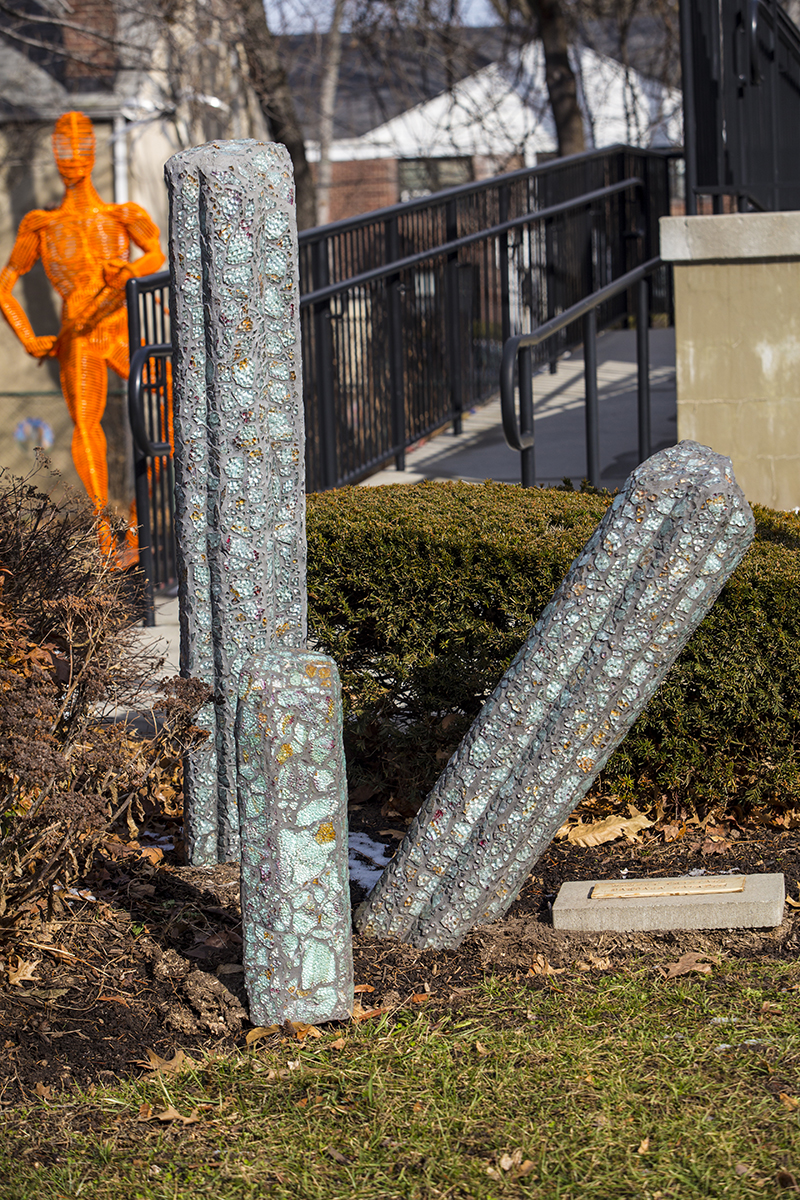
This mosaic piece is located in the sculpture garden and named “Memory crystals” – after the crystals used as storing devices in the Superman films. Researchers now claim that using ultra-fast lasers, we can now encode a piece of quartz with 5D information in the form of nano-structured dots separated by only one millionth of a meter. It is made of painted tempered glass, cement and grout.
Barbara Galazzo’s award-winning creations have been featured in major galleries, museums, and commercial installations. Her work is part of the permanent corporate collections of Kaiser Permanente, Washington DC; Northwestern Hospital, Chicago, Il; Fairmont Princess Hotel, Scottsdale, AZ; the Mayo Clinic, MN; and Ruth’s Chris Steakhouse, Knoxville, TN.
Galazzo is a curator, director and art promoter having created the ArtFull Living Designer Show House, Cold Spring Arts Open Studios Tour and is the curator/director of Gallery 66 NY in Cold Spring, NY.
For more information please visit www.galazzoglass.com

Wood, acrylic paint, 96” X 48” X 35”
“That’s the way it’s put together, flat planes leaning against each other, stable and yet not.” A metaphor for our lives, these painted wooden boards, cut into sweeping and angular shapes, lean and support each other into an interlocked form, stabilizing the other, yet acting in contrast. The brightly painted surfaces reach out towards the viewer, forms interacting with space, interacting with color. HOUSE of CARDS appears as an architectural structure until the viewer engages more closely, in which the solid shapes become more directional and vivid, painted, brushstrokes of color command the attention of space.
The artist, Beth Bailis, a native New Yorker, who lives and maintains a studio in Long island City, Queens, graduated from Maryland institute College of Art, and when returning to NYC, received an MFA from City College, CUNY. Primarily a painter, her work spans from landscape to abstracted compositions to mixed media configurations, entitled Fusion Paintings. Bailis is also a muralist, her most recent public mural is installed in the Roosevelt Island Motorgate Parking Garage in the entrance Atrium. Described by well known artist, Al Loving, whom Beth studied with, as “material madness”, her Fusion Relief Sculpture can be viewed currently at Unison Sculpture Garden in New Paltz, NY.
This piece, HOUSE of CARDS, has been exhibited at BWAC ( Brooklyn Waterfront Artists Coalition), annual sculpture show at Brooklyn Bridge Park in Dumbo, Saunders Farm Annual Sculpture exhibition with Collaborative Concepts in Garrison, NY, and Metalmen Sales in Long Island City, Queens, along with other Fusion works by the artist. Bailis’ art can be seen in the permanent collections of the City College Art Collection, William Whipple Museum at Minnesota State University, Wilson College, Chambersburg, PA, and long term loan at LaGuardia Community College, LIC, NYC.
For more information please visit www.bethbailis.carbonmade.com
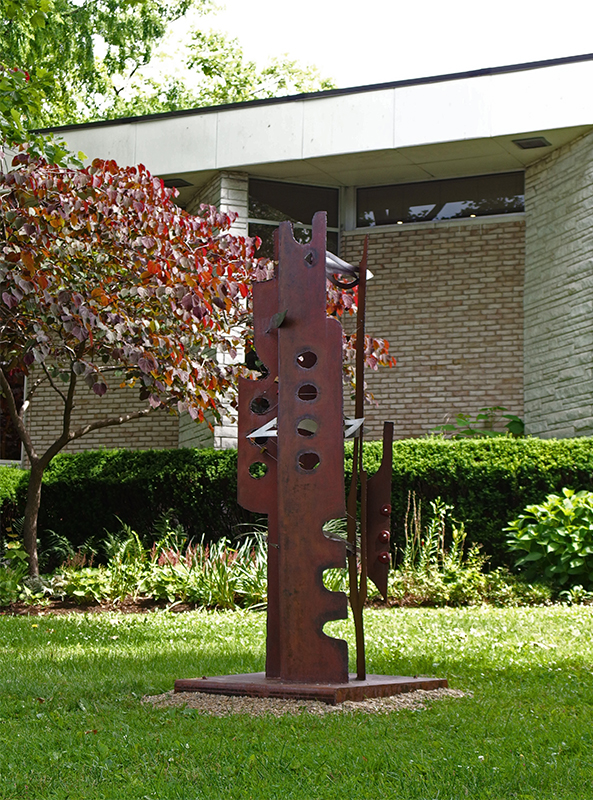
Various Metals & Sapele Mahogany 10′ x 4′ x 4′, Located on Fort Lee Road on the Leonia Public Library front lawn.
Continuing my journey on technology and farming this sculpture was inspired by the evolution of corn. Corn is a staple crop that’s importance lies on feeding the world. As the human population continues to rise we depend on farmers to increase global food production.
Farmers have been selecting the most productive plants and seeds from their crops for thousands of years. In the last quarter century, scientists have begun selecting productive traits at the individual gene level to create new seeds. Science has become the new machine farmers use to increase crop yields. But with this new machine, scientists have created corn plants that are no longer self-sustainable. It is now believed that if farmers stopped planting seeds tomorrow, corn would cease to exist.
“Corn Fields” sculpture represents the force between nature and science. Cables with wood pieces are woven through the structure representing genetic modification of the seed. The wood pieces symbolize the original seed thus creating the web of life.
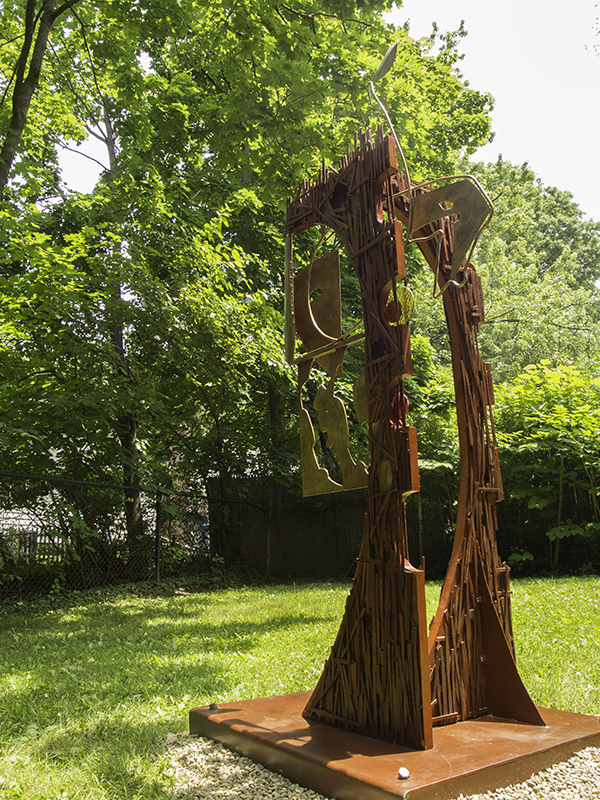
Metal, Sapele Mahogany & Glass 11′ x 2.5′ x 3′ Located in the Sculpture Garden.
This sculpture was inspired by Washington Irving’s Legend of Sleepy Hollow, weaving the region’s history of folk tales together with superstitions. Sleepy Hollow is known as the region of shadows and for the witching influence of the air. The best known celebration of this time of year stems from the Celtic festival of Samhain, where Celtic people had celebrations to ward off wandering ghosts. In the 19th century, the Irish immigrants brought this festival to America, which developed into Halloween. “The Legend” represents the love triangle that was the core theme in the Legend of Sleepy Hollow. The shapes of the horse’s head and hooves symbolizes not only the horse of Ichabod and the ghost of the Headless Horseman but also the dichotomy of America and Europe, a correlating theme Irving used throughout the essay. The sides of the sculpture are woven with wood and glass. The wood representing the vine of the pumpkin and the glass representing the pumpkin, the same as the Celtic legends have been woven into our culture. “The Legend” stands upright allowing the viewer to see shadows through the openings created by the different dimensions. These shadows create the bewitching feeling of the legend. Your eye ends at the top of the sculpture with a reflective metal pumpkin head bringing to the conclusion the complexity of Sleepy Hollow.

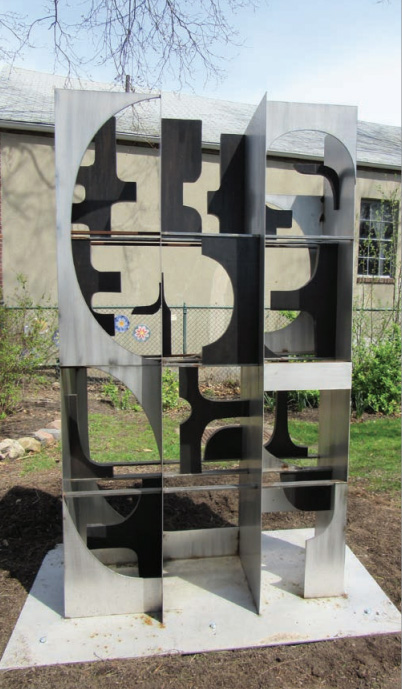
For more information please visit http://sburokerstudio.com
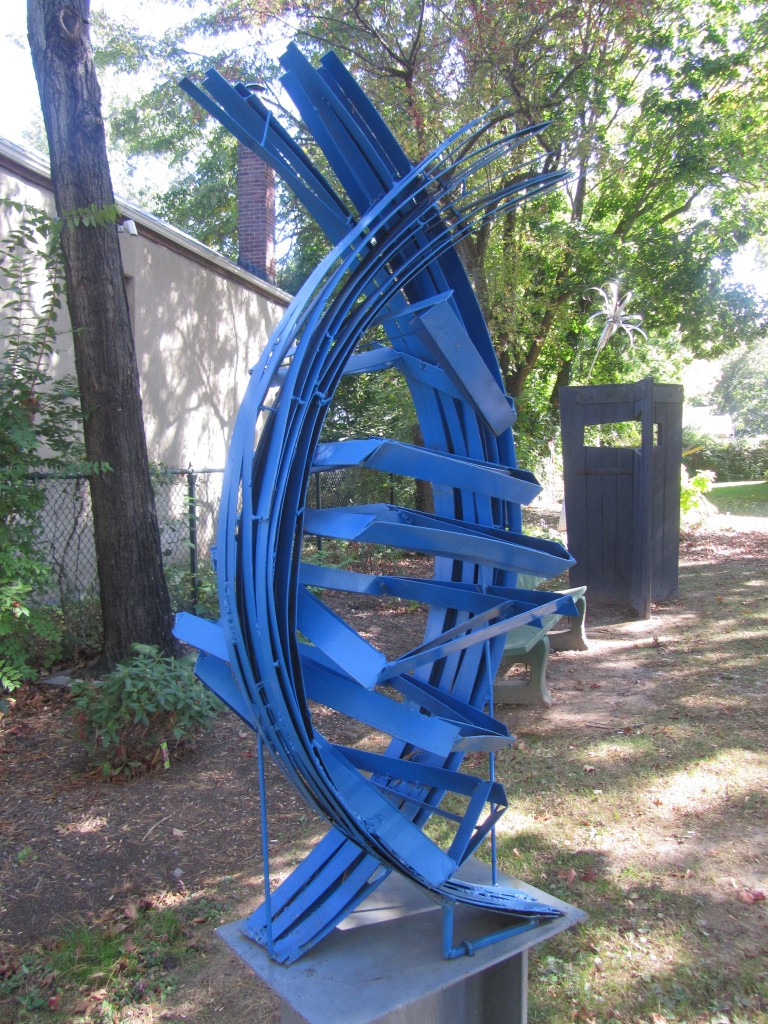
Welded steel 48” high
Don started figurative sculpting as a young man, then worked as a clinical psychologist. When he got back to his art it evolved from figurative to abstract. Breaking free of true anatomy was liberating. This piece is powder coated steel, sprayed in a rich blue color to enhance the form.
For more information please visit donsaco.com

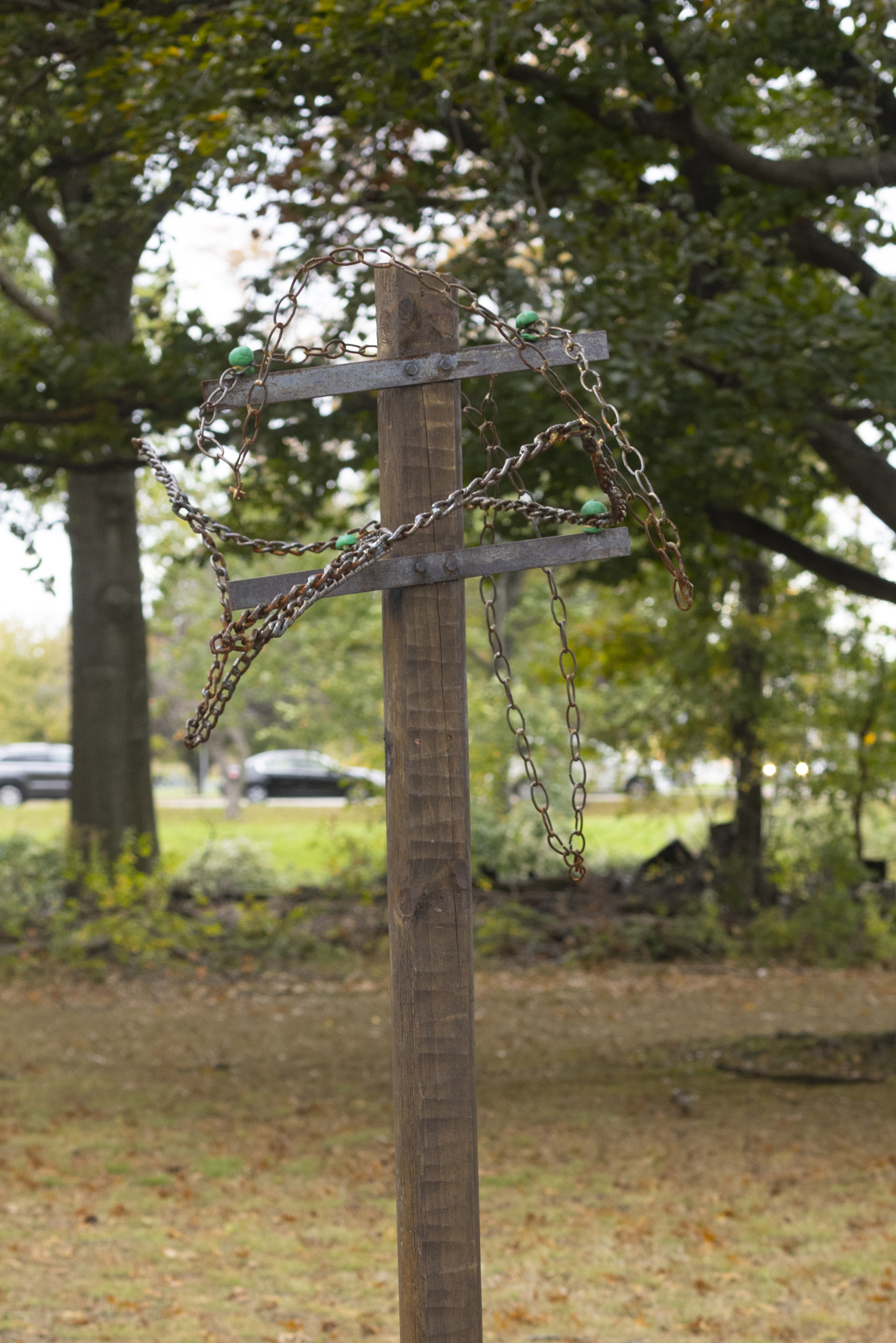
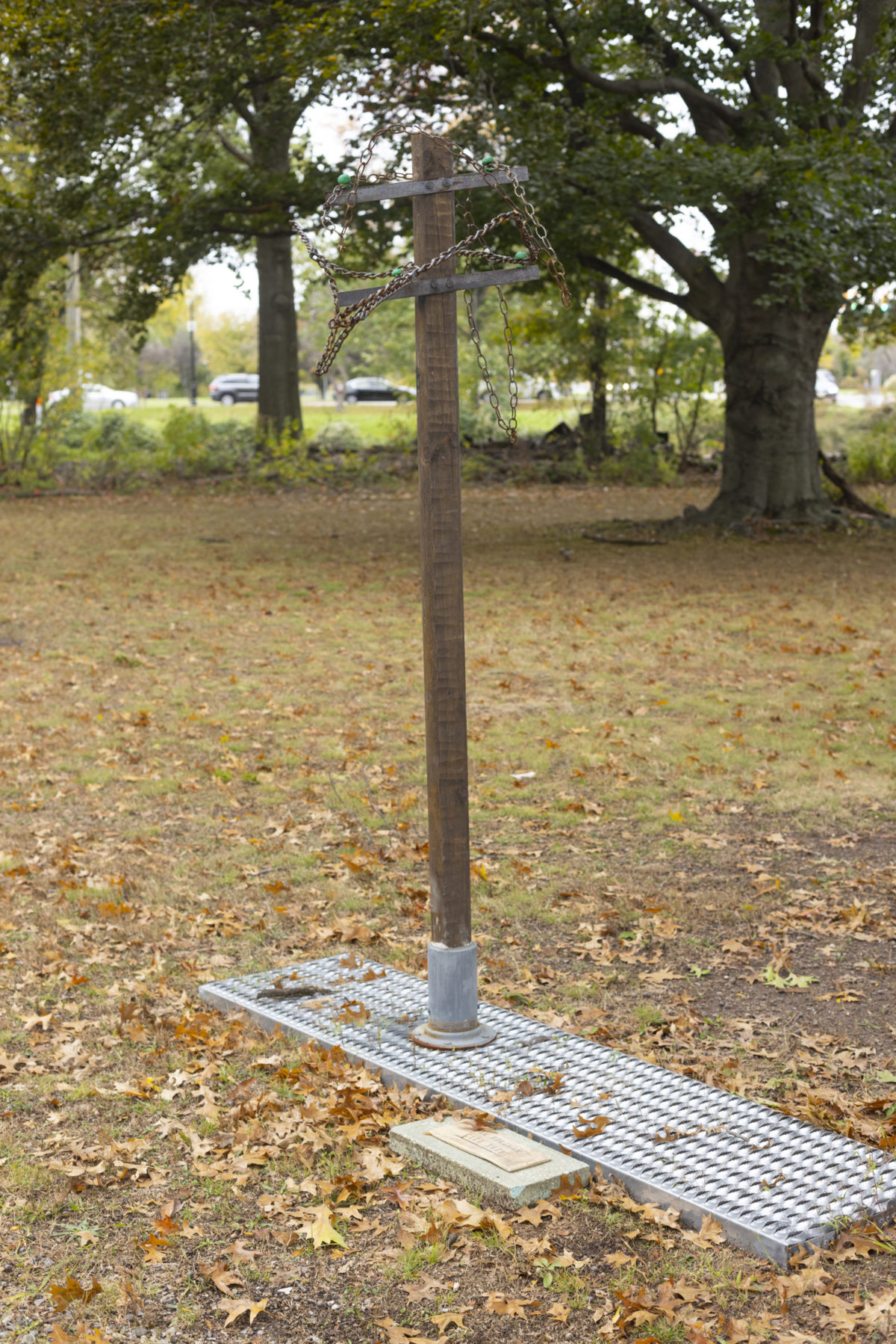
“City Tree” is a simulated telephone pole crowned with a blizzard of wires. This kind of tree is gradually replacing the native trees of New Jersey.

Traditionally a sculptor who works with metal, Dan Bergman veered to wood with the creation of “My Father’s House.” The carved out space in this sculpture represents the house. It is visible from every angle of the three-paneled display.
Here, Dan describes his fascination with houses and his artistic intensions for “My Father’s House.”
Dan Bergman grew up in Chicago and Cleveland. After a 30-year business career, he began studying at New York’s Art Students League. His sculpture has been exhibited in many solo and group shows, and he has executed a number of public works. He is known for intense, convoluted welded pieces, wind-driven kinetic works, and explorations of mathematical structures such as “tensegrity”.
My Father’s House has been generously donated to the Borough of Leonia.

Originally a painter, Grace Knowlton has traveled freely through various art forms, methods, and materials. In the past she has had exhibitions that included works of her photographs, drawings, paintings, and sculptures – the latter made from both natural and synthetic materials. All of the works are made from copper and show various stages of patination. The surfaces – from the dulled copper to the white patina – come from the various solutions applied to the shell-like enclosures and from their exposure to the elements of nature. The organic seams that join the sheets of copper and the mossy coloration and textures combine to make surfaces that are extraordinarily evocative. The artist has said, “I could tell you my sculpture is informed by the inner space, that I place it in the context of interrelated forms, or I could talk about the significance of surfaces. Actually I am a magician – I create through an ancient practice involving the laying on of hands.” In these sculptures different forces of texture, form, space, and color compose a galaxy of natural strengths.
Grace Knowlton has exhibited extensively throughout the United States. Her work is in the collections of The Metropolitan Museum of Art, The Brooklyn Museum of Art in Brooklyn, The Victoria and Albert Museum in London, the Yale University Art Gallery in New Haven, among many others.
For more information please visit graceknowltonart.com
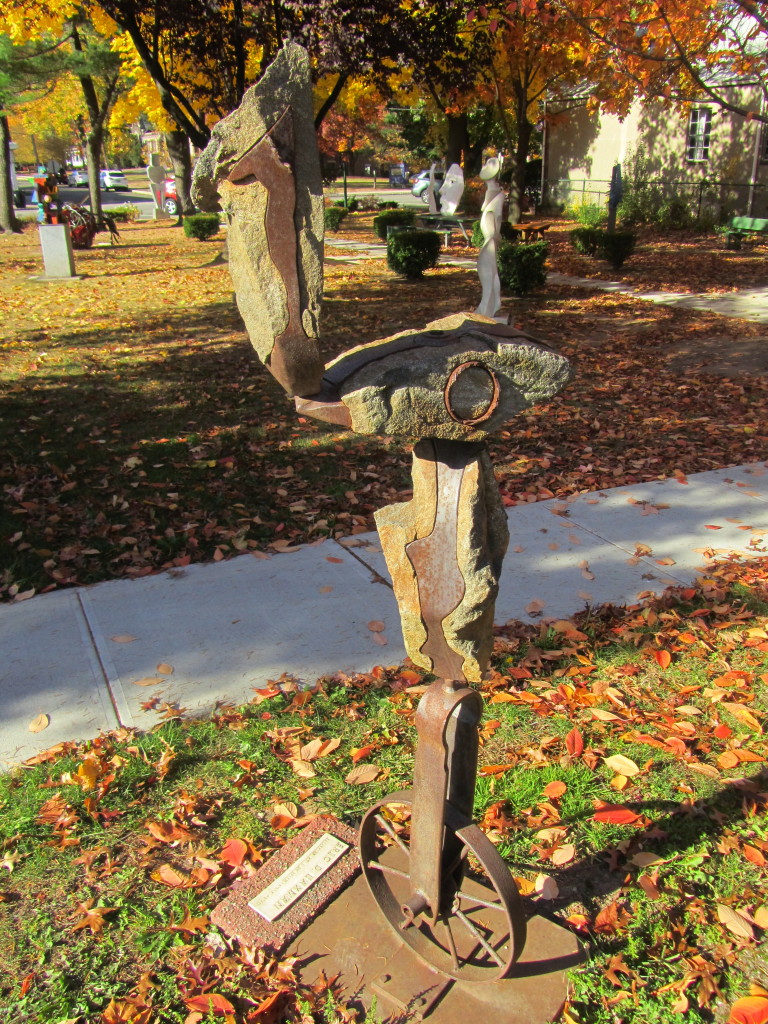
Eric David Laxman is an accomplished sculptor and furniture designer who has created a unique studio and showroom at the Garnerville Art and Industrial Center near Haverstraw, New York. He has exhibited his diverse works throughout the metropolitan area and nationwide. Laxman was awarded the Rockland County Executive Art Award for Visual Artist in 2007 and was recognized by Rockland’s business community in the “Forty Under Forty” Award Ceremony. Laxman has recently completed a large sculpture commission for the City of Sculpture in Hamilton, Ohio and has completed commissions for the Greenwich Hospital in Connecticut and the Summit Medical Group in New Jersey.
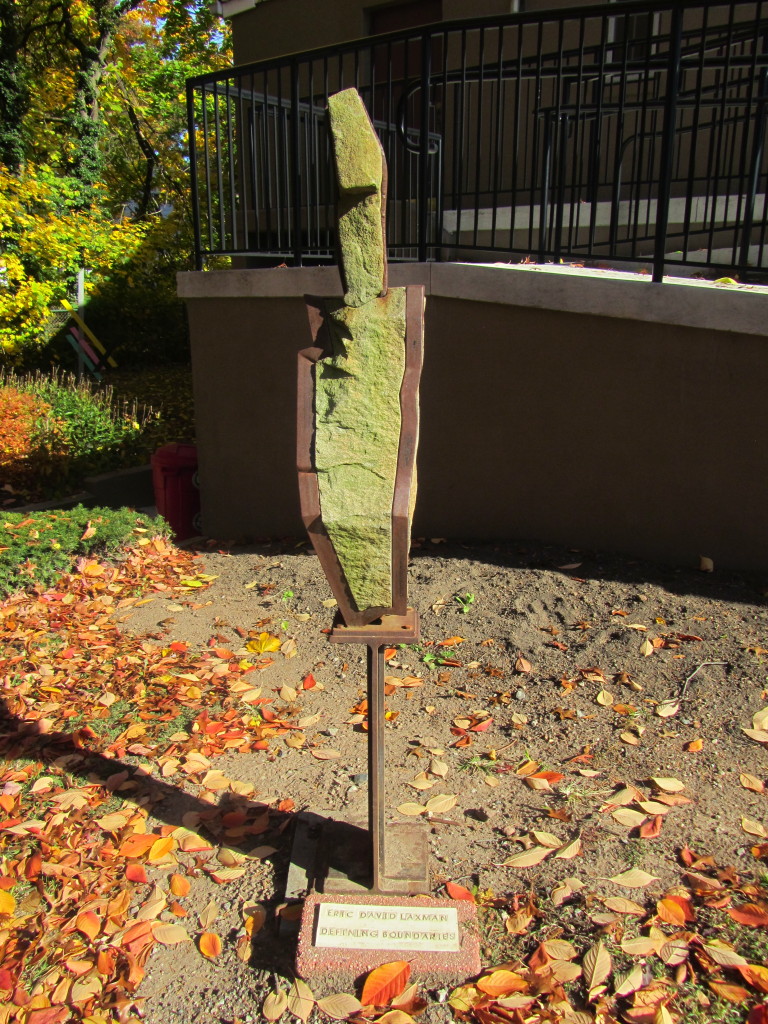
In the past ten years he has extended his unique sculptural sensibility into the realm of metal furniture and functional art. His custom furniture and sculpture has been featured in The New York Times, Journal New Home Design Magazine, The Artful Home, Hudson Valley Magazine, The Hook, Metrohouse Magazine, Rockland Magazine and Rivertown.
Laxman writes: “For me sculpture is a personal journey and exploration that helps me understand and make sense of the world around me. In the sculptures presented here, I have physically wrestled with hard stone and metal in order to develop a means for integrating disparate elements into coherent abstract and figurative compositions. This is fueled by a desire to express the themes and transformation, growth, balance and movement.
“It is my intention to create sculptures that seem spontaneous and inevitable using a process that is extremely labor intensive and deliberate. Seeking is a constant; to transform my materials while at the same time respecting and acknowledging their unique properties and their raw fundamental nature. This duality, a recognition of the discreet parts and the creation of a new unified whole is the essence of my creative process.
“Cutting, drilling, splitting, and breaking marble and granite; forging, welding, and reassembling steel and bronze has become a metaphoric struggle for achieving balance.”
For more information, please go to: EricDavidLaxman.com

This piece is located on the front Library lawn on Fort Lee road.
In the sculpture of James Murray, space, interval, and matter are constructed together with a vigor and finesse that frequently defy expectation. Murray initiates his work through an all-inclusive approach to new and pre-existing materials. The artist seeks: “the erosion of time and age—all welcome to evoke the mysterious power of simple form and surface.”
Murray relies on unusual means to forge these coherences. From experience navigating ships as a merchant marine captain, a one hundred-ton master, he intuits trajectory lines through space. In his lifelong work as a sculptor, he manipulates abstract chunks of form or a specific image of a basic house shape as if guiding ships tossed on waves. Objects under his watch never fall out of range but hold to the edge. The stacked stones and wood blocks are drilled to receive an internal metal rod invisible to the viewer who must suspend disbelief in order to approach and reconfigure the piece.
For more information jameshmurray.com